How to Achieve Continuous Audit Readiness in 2026
-
 Balachandran Sivakumar
 - 27 Apr, 2026
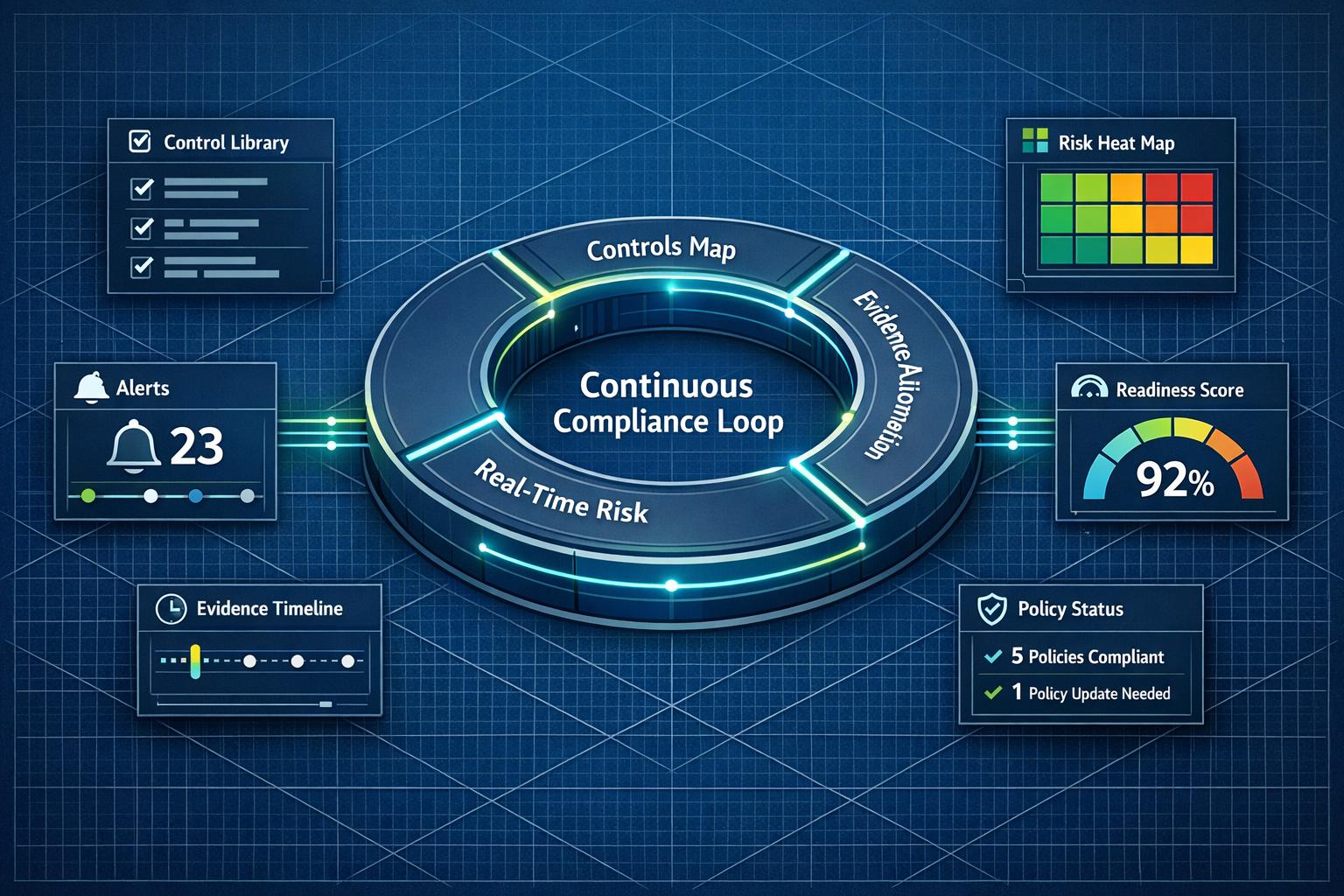
In 2026, organisations face mounting compliance challenges with rapidly changing AI models, cloud configurations, and evolving regulations like India’s DPDP Act and the EU AI Act. Traditional, manual compliance methods are no longer sufficient. The solution? Continuous audit readiness powered by AI-driven platforms.
Key Insights
- Audit fatigue is a growing risk, with 63% of CISOs listing it as a top operational concern.
- 40% more time is spent on audits compared to three years ago.
- 95% of compliance violations stem from human error and weak controls.
What You Need to Do
- Assess gaps: Identify compliance weaknesses like outdated controls and scattered systems.
- Map controls: Use AI tools to align overlapping frameworks (e.g., ISO 27001, SOC 2, GDPR).
- Automate evidence collection: Implement AI agents to gather, validate, and monitor data in real time.
- Use dashboards: Track compliance health with visual tools for faster remediation.
- Ensure accountability: Assign clear ownership for controls and remediation tasks.
AI-driven platforms like CISOGenie simplify compliance by integrating frameworks, automating processes, and reducing audit preparation time by up to 70%. This shift isn’t just about meeting regulatory requirements; it positions organisations to handle the dynamic demands of modern systems efficiently.
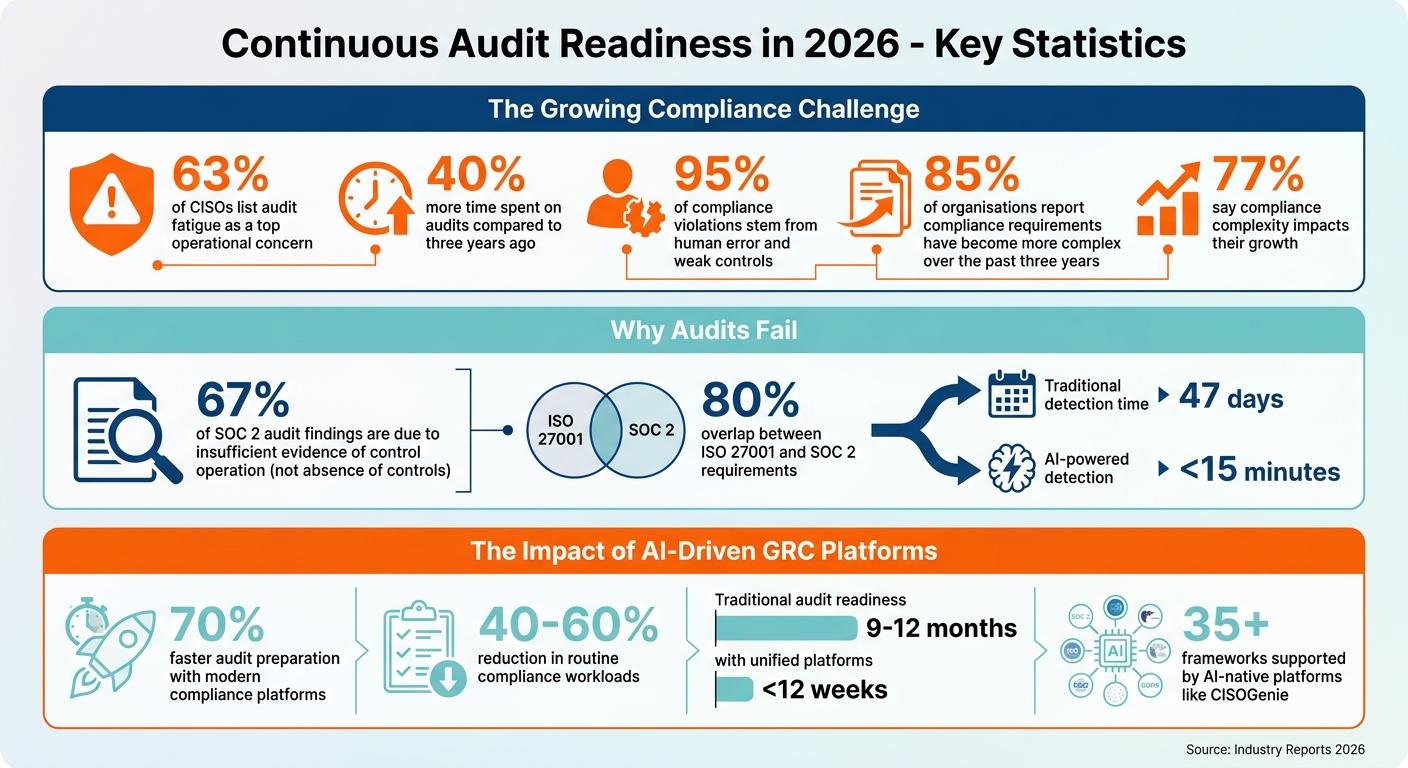
Continuous Audit Readiness Statistics and Key Metrics 2026
Assess Your Current Compliance Gaps and Challenges
Before you can fix compliance issues, you need to identify them. Many organisations only realise their compliance weaknesses during audits. To prepare for continuous audit readiness, the first step is an honest evaluation of where your current processes fall short. A detailed gap analysis is key to making this transition.
One major challenge is compliance drift - the gap between the standards met during past audits and the current state of operations. This is a serious risk. For example, your controls might have been effective six months ago, but with frequent changes to cloud configurations, they can quickly become outdated. To make matters more challenging, 85% of organisations report that compliance requirements have become more complex over the past three years. This creates a constantly shifting target that manual processes struggle to keep up with.
The signs of trouble are easy to spot. If your team relies on scattered spreadsheets to track controls, spends weeks chasing colleagues for missing documents, or uncovers unexpected issues only during formal audits, you’re likely dealing with fragmented systems. These inefficiencies delay evidence gathering and weaken your documentation. It’s worth noting that 95% of compliance violations are due to human error and weak controls, not malicious intent. These issues are often the result of disorganised systems and manual workflows.
Map Controls Across Multiple Frameworks
To streamline your compliance efforts, start by creating a unified view of your controls. Treating ISO 27001, SOC 2, GDPR, and India’s DPDPA as entirely separate programmes leads to unnecessary duplication. In fact, ISO 27001 and SOC 2 share an 80% overlap in their requirements.
Modern GRC platforms can simplify this process using AI to automatically cross-map controls. For example, a single encryption control can address requirements for ISO 27001, SOC 2, GDPR’s Article 32 (security of processing), and DPDPA’s Section 8 (reasonable security safeguards). This approach not only eliminates duplicate work but also ensures nothing is overlooked as regulations evolve. When mapping controls, remember to include sector-specific mandates from RBI and SEBI alongside global standards. India’s regulatory landscape demands that organisations balance both global and local requirements.
Once your controls are mapped, take a closer look at process inefficiencies to identify additional weak spots.
Identify Common Pain Points
One of the biggest hurdles is organisational. Unclear ownership often means no one takes responsibility when a control fails. To prevent this, every control should have a single, accountable owner. Without clear accountability, reviews can be missed because everyone assumes someone else is handling them.
Fragmented tools also create confusion. When policies are stored in one system, risks in another, and incidents in yet another, even straightforward audit requests can take weeks. By contrast, organisations using modern compliance platforms report 70% faster audit preparation because they’ve eliminated these inefficiencies.
Another major issue is retroactive evidence collection. Waiting until an audit begins to gather proof often results in incomplete or outdated records - and auditors can easily spot this. The solution is to automate evidence collection and align it with your risk profile. Whether the proof comes from system logs, API exports, or access records, collecting it regularly ensures you’re always prepared. Fixing these organisational issues is essential to fully leveraging an AI-driven GRC platform.
These steps lay the groundwork for automating evidence collection and achieving real-time compliance monitoring.
Automate Evidence Collection and Compliance Monitoring
After mapping your controls and identifying any gaps, the next logical step is to move away from manual evidence gathering. This is where AI-powered automation steps in, transforming audit readiness from a frantic, periodic task into a seamless, continuous process. In the fast-evolving compliance landscape, automated evidence collection has become indispensable. Interestingly, over half of risk and compliance functions are already experimenting with or actively using AI for this purpose. This shift allows organisations to transition from outdated manual methods to automated, real-time evidence collection.
Manual evidence gathering is not only slow but also prone to errors. For instance, 67% of SOC 2 audit findings are due to insufficient evidence of control operation, not the absence of the controls themselves. The issue isn’t about lacking controls; it’s about proving they consistently work. Automated platforms address this by slashing the time to detect compliance deviations - from an average of 47 days to under 15 minutes.
Deploy AI Agents for Evidence Collection
Modern Governance, Risk, and Compliance (GRC) platforms leverage AI agents to handle evidence collection, normalisation, and validation automatically. These agents integrate directly with your cloud services (like AWS or Azure), identity systems (such as Okta or Google Workspace), and code repositories (like GitHub or GitLab), pulling real-time data with no manual effort. For example, a single encryption control can generate evidence for multiple compliance frameworks - ISO 27001, SOC 2, GDPR’s Article 32, and India’s DPDPA Section 8 - all from the same source.
What sets these AI agents apart is their intelligence. They don’t just gather data; they validate the health of controls, assess their effectiveness, and even trigger remediation when something goes wrong. For instance, if an unencrypted database is detected, the system can automatically flag it, notify the responsible team, and log the incident for auditors - all without human intervention.
This creates what is often called an “Audit Hub” or “Trust Centre”, where auditors can access timestamped, tamper-proof evidence whenever needed. Say goodbye to last-minute evidence hunts. By automating these processes, organisations minimise errors and ensure continuous audit readiness throughout the year.
To get started, focus on integrating the systems that handle the highest volume of compliance-related tasks. Prioritise cloud providers, identity management tools, and HR systems to automate routine tasks like access reviews, system reports, and training attestations. This approach delivers quick wins and builds momentum for expanding automation efforts. Once in place, automated evidence collection lays the groundwork for real-time monitoring through dynamic risk dashboards.
Enable Real-Time Risk Dashboards
Real-time dashboards give organisations instant insight into control health, overdue tasks, and compliance gaps. These dashboards use visual heatmaps to help prioritise remediation efforts. Alerts can be configured by severity: critical issues - like a publicly accessible database or a missing encryption key - should prompt immediate action, while less urgent problems can be grouped into weekly summaries to avoid overwhelming users with notifications.
Dashboards can also be tailored to meet specific regulatory requirements. For instance, you might have a “DPDP India Evidence View” or an “EU AI Act Evidence View” to manage cross-border compliance. This level of customisation ensures organisations stay on top of diverse regulatory demands without losing sight of the bigger picture.
Build a Unified Platform for Multi-Framework Compliance
Combining automated evidence collection with real-time dashboards, creating a unified compliance framework offers a streamlined and efficient solution.
Managing compliance across multiple frameworks often involves juggling fragmented tools and scattered data. In fact, 85% of organisations report growing complexity in compliance, while 77% say it impacts their growth. The answer lies in consolidation. A unified GRC platform eliminates repetitive tasks by recognising overlapping requirements across frameworks. For example, a single encryption control can address criteria in more than 50 frameworks at once.
This approach shifts compliance from being a manual, fragmented process to what experts call a “Compliance Fabric” - an AI-driven layer that continuously interprets regulations and aligns them with internal systems in real time. The benefits are striking: organisations can cut the time needed for audit readiness from the usual 9–12 months to less than 12 weeks. As Raktim Singh explains, “Static compliance cannot keep up with dynamic systems and dynamic laws. You cannot run a real-time AI enterprise with annual compliance rituals”.
This consolidated framework also sets the stage for continuous monitoring and improved vendor risk management.
Integrate Continuous Monitoring and Vendor Risk Management
A unified platform isn’t limited to internal controls - it extends oversight to your entire operational ecosystem. By directly integrating with tools like cloud infrastructure (AWS, Azure), SIEM systems, identity platforms (Okta, Google Workspace), HR solutions, and ticketing systems like Jira or ServiceNow, the platform gathers real-time data from across your organisation. This enables continuous controls monitoring, replacing periodic snapshots with ongoing, real-time visibility.
Vendor risk management also becomes more effective when integrated into the same platform. Instead of treating third-party assessments as isolated tasks, the system proactively evaluates vendors’ security postures during onboarding, aligning them with your internal framework requirements. Advanced features like sovereignty and geo-fencing help track data location and enforce regional regulations, ensuring compliance with GDPR, India’s DPDP, and the EU AI Act. This is especially crucial for organisations operating across borders, where even minor missteps can result in penalties.
Such deep integration also supports automated policy management and risk-driven remediation.
Use CISOGenie for Autonomous GRC Workflows
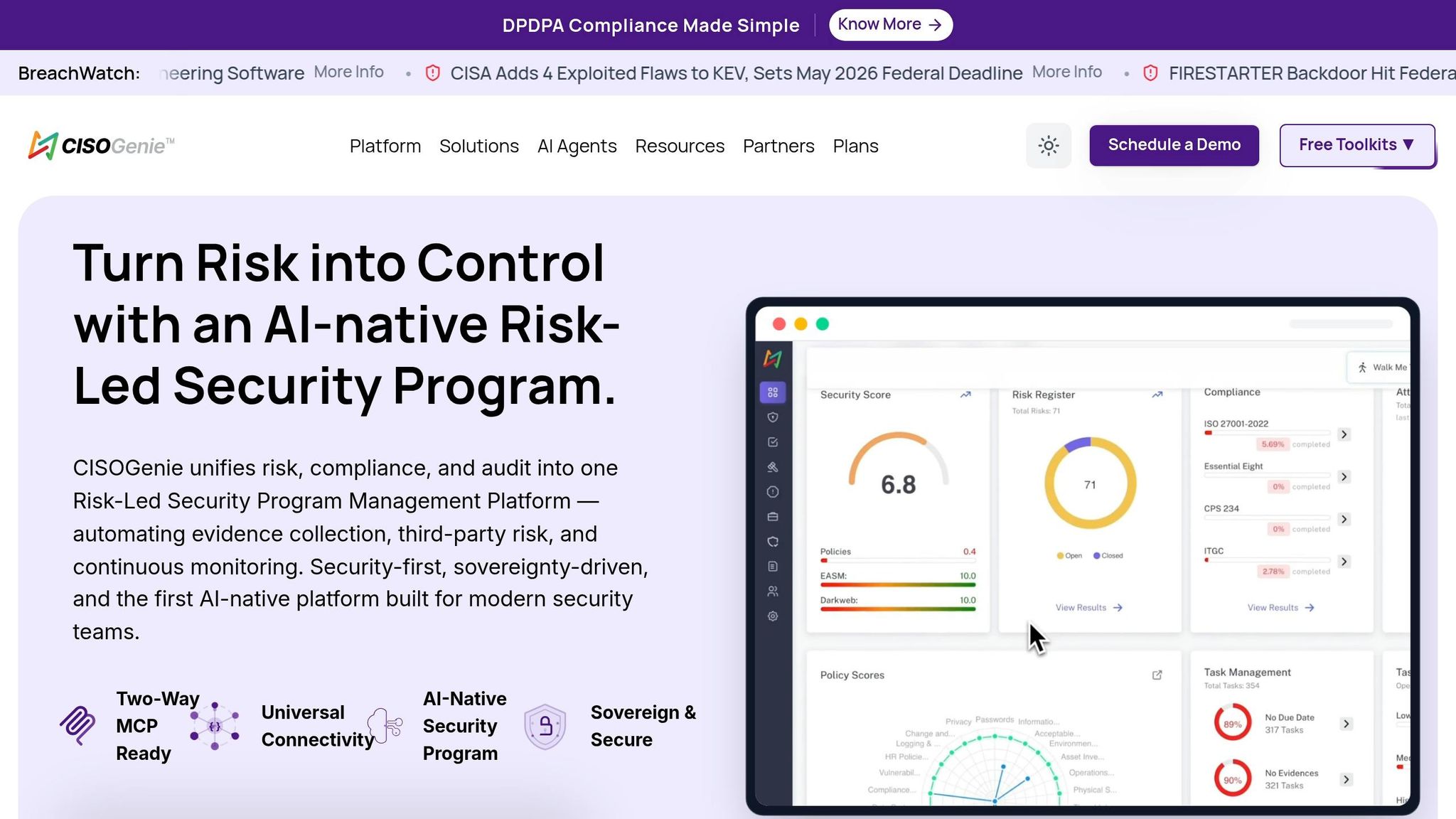
CISOGenie exemplifies the shift towards autonomous GRC systems, using AI to classify risks, recommend remediation steps, and draft technical documentation. Designed as an AI-native platform, CISOGenie automates policy management while supporting compliance for 35+ frameworks, turning static policy documents into dynamic, machine-readable controls. It employs OSCAL (Open Security Controls Assessment Language) to standardise compliance data, enabling systems to automatically validate and enforce controls.
The platform automates tasks like policy updates, notifications, and attestation tracking, ensuring controls remain current and auditable. Its AI agents manage evidence collection, validation, and risk profiling, creating tamper-proof audit trails accessible to auditors on demand. By treating controls as code and storing them in version-controlled repositories, CISOGenie transforms audits from disruptive processes into straightforward verification tasks. This marks a shift from reactive preparation to continuous audit readiness, making compliance an ongoing, seamless process.
Implement Risk-Led Remediation and Accountability
With automated evidence collection and unified monitoring in place, the next step is tackling risks efficiently and ensuring clear accountability for remediation. A unified GRC platform plays a central role by streamlining risk prioritisation and fostering cross-functional ownership, making continuous audit readiness a reality.
Prioritise Risks and Automate Remediation
Not all compliance gaps carry the same weight. AI-powered platforms can analyse historical findings, control trends, and regulatory exposure to zero in on areas with the greatest audit impact. This targeted approach ensures teams address the most critical issues first, rather than spreading efforts thinly across all alerts.
These platforms go further by automating the remediation process. They classify risks, generate detailed remediation steps, and produce technical documentation. For example, when a control fails, the system flags it, creates a remediation ticket in tools like Jira or ServiceNow, assigns it to the right person using real-time HR data, and sets up escalation triggers if the issue isn’t resolved promptly. Some advanced systems, like Compliance Fabrics, can even take immediate action by blocking risky behaviours, such as unauthorised data transfers, in real time.
One vital metric to track is “Time to Remediate Failed Controls.” This KPI not only demonstrates operational discipline to regulators but also highlights persistent structural weaknesses. To ensure smooth workflows, it’s essential to standardise controls before automating them. This prevents existing inconsistencies from being amplified and keeps remediation processes from disrupting daily operations.
Create Cross-Functional Accountability
Clear ownership is the backbone of effective remediation. Each control should have a designated owner who is responsible for its execution, review, and remediation. Assigning ownership based on functional expertise ensures accountability is both logical and effective. For instance:
- IT teams handle system access reviews and vulnerability patching.
- HR oversees training completion and policy attestations.
- Operations manage process-specific controls.
For seamless intervention when control owners are unavailable, an escalation matrix is crucial. Embedding these workflows into everyday tools like Slack or Microsoft Teams helps integrate compliance into daily routines, making it less of a separate task and more of a natural part of operations. Monthly performance reviews replace outdated annual cycles, helping to detect “control drift” and verify the effectiveness of remediation actions.
| Role | Key Responsibilities |
|---|---|
| IT/Security | System access reviews, vulnerability patching, encryption monitoring |
| HR | Training completion, policy attestations, role-based permission updates |
| Legal/Compliance | Regulatory mapping, policy updates, audit response coordination |
| Operations | Process-specific control execution, incident reporting, vendor performance |
Conclusion
In 2026, staying prepared for audits isn’t about working harder - it’s about working smarter. By using AI automation and unified GRC platforms, as discussed earlier, the approach to audit readiness shifts from being occasional to becoming a continuous process. This transformation relies on three key changes: automating repetitive tasks, adopting a unified platform to break down silos, and embedding risk-focused accountability into everyday operations.
AI-driven tools like CISOGenie make this shift achievable. These platforms consolidate controls, policies, and evidence into a single source of truth, eliminating fragmented workflows and those stressful last-minute scrambles for documentation. The results speak for themselves: organisations can achieve SOC 2 audit readiness up to 70% faster while reducing routine compliance workloads by 40–60%.
The bigger picture here is moving beyond “point-in-time” certifications to building continuous trust. Industry experts agree that static compliance models can’t keep up with the dynamic nature of modern systems and evolving regulations. With frameworks like the EU AI Act and India’s DPDP Act reshaping compliance expectations, being able to showcase real-time security is no longer just a regulatory requirement - it’s a competitive edge.
To get started, focus on automating processes in your most critical risk areas, such as vendor risk management, access reviews, or evidence collection. But remember, standardising controls first is crucial to avoid magnifying any existing inconsistencies. The ultimate goal is to adopt a platform that views compliance as an ongoing operational practice, not just an annual obligation. This shift is critical as you integrate AI-powered solutions into your compliance strategy.
FAQs
What does continuous audit readiness mean in 2026?
In 2026, being prepared for audits isn’t just about scrambling to gather documents when the time comes. It’s about maintaining compliance every single day through real-time monitoring, automation, and integrated controls. This proactive approach ensures that organisations can consistently demonstrate the effectiveness of their controls.
Key aspects include automating evidence collection, streamlining processes, and managing compliance across multiple frameworks such as ISO 27001, SOC 2, and GDPR. By doing so, businesses can reduce manual workloads, avoid audit delays, and adapt more easily to ever-changing regulatory demands.
Which systems should we connect first for compliance automation?
To streamline your Governance, Risk, and Compliance (GRC) processes, start by using systems that centralise GRC management and facilitate compliance with multiple frameworks like ISO 27001, SOC 2, and GDPR. The key is to integrate your GRC platform with tools for managing controls, policy workflows, and evidence collection.
This integration helps automate essential tasks like evidence gathering, control monitoring, and reporting. The result? You’re always ready for audits, minimise delays, and build a compliance system that scales effortlessly while staying aligned with changing regulations and standards.
How do we prove controls are working across SOC 2, ISO 27001 and DPDP?
Proving that controls are effective across frameworks like SOC 2, ISO 27001, and DPDP means showing they work as intended through continuous monitoring and automated evidence collection. AI-powered GRC platforms simplify this process by automating control testing, enforcing policies, and providing real-time dashboards to monitor performance. These platforms make it easier to manage compliance across multiple frameworks by mapping controls and evidence to various standards, ensuring you’re always prepared and cutting down on audit delays.