Dark Web Monitoring for CISOs: How to Turn Breach Intelligence into GRC Action
-
 Balachandran Sivakumar
 - 18 May, 2026
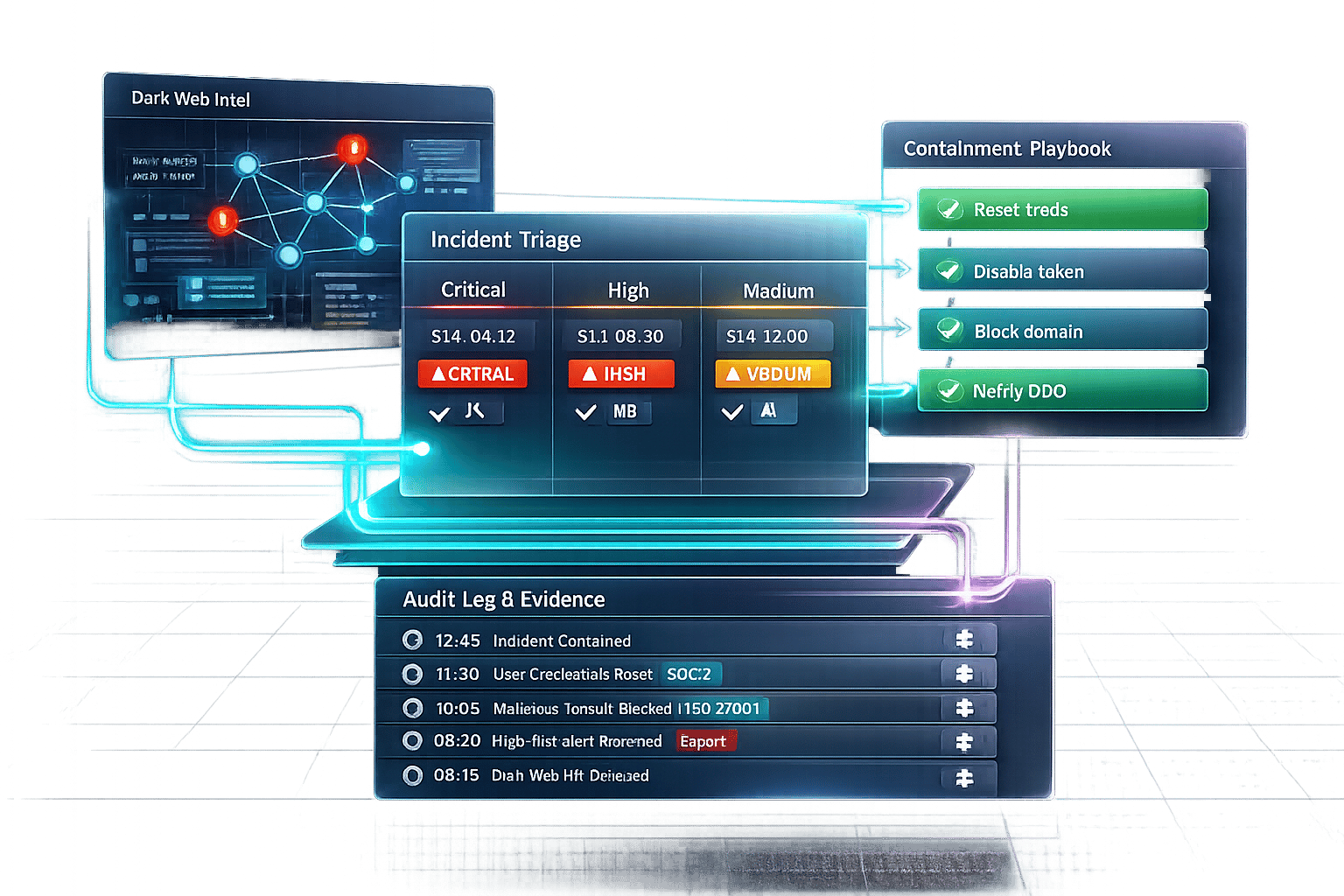
Most organisations take 197 days to detect a breach. By then, credentials are sold, ransomware is active, and compliance deadlines loom. Dark web monitoring changes this, reducing breach discovery to hours, not months. For CISOs, it’s not just about faster detection - it’s about meeting regulations like GDPR’s 72-hour breach notification rule and turning intelligence into actionable Governance, Risk, and Compliance (GRC) measures.
Here’s what you need to know:
- What to Monitor: Focus on critical assets - executive emails, admin credentials, VPN/RDP access, vendor risks, and customer data.
- Ownership: Assign responsibilities across teams (for example, Legal for employee PII and Vendor Risk Management for third-party exposure).
- Triage Alerts: Prioritise high-confidence signals (for example, leaked admin credentials or fresh stealer logs) and act quickly.
- Map to Compliance: Align findings with frameworks like SOC 2, GDPR, and ISO 27001 to ensure compliance and audit readiness.
- Automate Responses: Use AI to speed up containment actions - password resets, session token revocations, and MFA re-enrolments.
Dark web monitoring isn’t just a security tool - it’s a way to stay ahead of threats and keep your organisation audit-ready. The key is connecting breach intelligence to your GRC framework and acting fast.
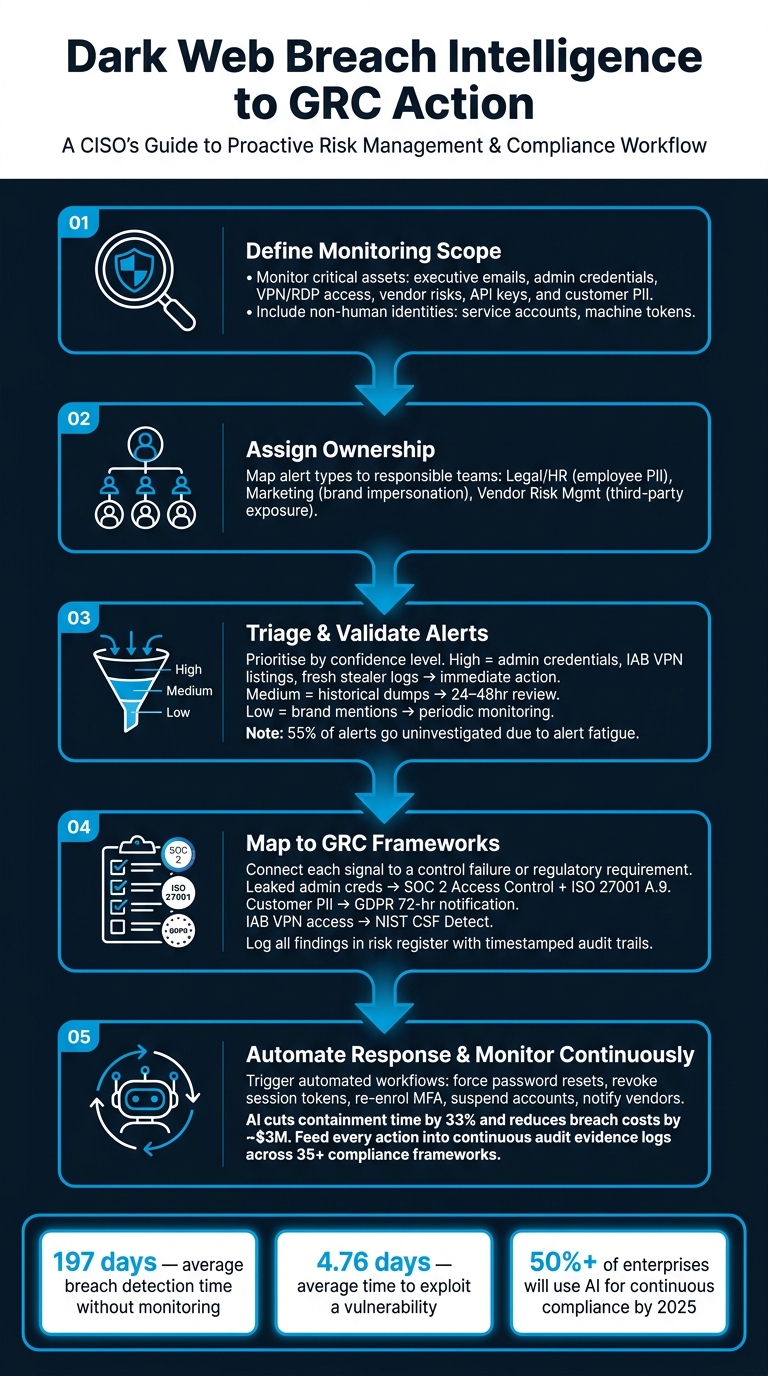
Dark Web Breach Intelligence to GRC Action: 5-Step Workflow for CISOs
Defining the Scope of Dark Web Monitoring
Setting a clear scope is essential to filter out irrelevant data and focus on dark web intelligence that aligns with your organisation’s risk profile.
Key Monitoring Targets
| Asset Category | Specific Data Points to Monitor | Why It Matters |
|---|---|---|
| Identities | Executive emails, admin credentials, session tokens, employee PII | Prime targets for social engineering and privilege escalation. |
| Infrastructure | Corporate domains, IP ranges, VPN/RDP access listings | Can signal Initial Access Broker activity. |
| Third-Party Risk | Vendor names, SSO provider credentials, CRM system leaks | Helps mitigate supply chain “side-door” attacks. |
| Proprietary Data | Source code, internal docs, API keys | Protects intellectual property and reduces backdoor risk. |
| Customer Data | PII, payment details, database dumps | Supports GDPR, DPDPA, and PCI DSS obligations. |
Also monitor non-human identities such as service-account tokens and cloud API keys for AWS, Azure, and Okta. These are increasingly traded on dark web forums.
Assigning Ownership and Responsibility
Map each alert class to the team best equipped to act:
- Legal/HR for employee PII and insider-related exposure
- Marketing/Comms for brand abuse and phishing impersonation
- Vendor Risk for third-party and sub-processor exposure
This keeps threat intelligence flowing into continuous compliance workflows instead of sitting unresolved in security queues.
Alert Triage and Breach Validation
With high alert volumes, triage discipline matters. Prioritise by freshness, exploitability, and business impact.
Identifying High-Confidence Breach Signals
- Treat fresh stealer logs (1-7 days) as higher urgency than old dumps.
- Validate against internal auth logs (Okta, AWS, M365) for abnormal login patterns.
- Use canary tokens or decoy credentials to verify active compromise paths.
Escalation vs Scheduled Review
| Alert Type | Confidence | Action |
|---|---|---|
| Admin or executive credentials leaked | High | Immediate escalation: reset passwords, re-enrol MFA, revoke sessions |
| VPN/RDP access offered by IAB | High | Investigate immediately and restrict access paths |
| Fresh API keys/session artifacts | High | Rotate keys and revoke sessions immediately |
| Historical breach dump | Medium | Schedule review and validate account hardening |
| Brand chatter/general mentions | Low | Monitor periodically and involve Legal/Comms if needed |
Use strict SLAs so critical alerts are not buried under low-value noise.
Mapping Breach Intelligence to GRC Frameworks
A dark web alert has limited value until it is mapped to control obligations, risk records, and evidence workflows.
How Breach Findings Affect Compliance Frameworks
| Dark Web Signal | GRC Framework Impact | Required Action |
|---|---|---|
| Leaked admin credentials | SOC 2 Security, ISO 27001 A.9 | Trigger MFA reset and log control failure |
| Customer PII for sale | GDPR/DPDPA notification duties | Start incident response and notification assessment |
| VPN access listed by IAB | NIST CSF Detect, SOC 2 Security | Update risk register and run adversarial checks |
| Vendor compromise mention | ISO 27001 supplier controls | Trigger third-party risk assessment |
| Stolen session tokens | SOC 2 Confidentiality | Revoke sessions and update identity-control evidence |
Using Breach Evidence for Audit Readiness
Each validated finding should:
- update the risk register,
- create timestamped evidence records,
- open remediation tickets,
- and track closure for audit defensibility.
This creates a closed loop between detection, response, and compliance proof.
Automating Response Workflows for Breach Alerts
Speed is decisive. Manual response cannot keep up with modern exploitation windows.
Key Response Actions
Automate as defaults:
- forced password resets,
- active-session revocation,
- MFA re-enrolment,
- account suspension where needed,
- vendor notification and follow-up.
For high-impact actions, keep one-click human approval gates.
How AI Cuts Response Time
AI-driven workflows can:
- rapidly validate leaked credentials against identity systems,
- prioritise exploitable exposures,
- trigger playbook actions in near real time,
- and write remediation evidence automatically for audit trails.
Platforms like CISOGenie can connect this flow to broader GRC controls so SOC 2 and ISO 27001 evidence is built continuously, not assembled at audit time.
Maintaining Continuous Monitoring and Audit Readiness
Centralising Alerts and Evidence Logging
Unify dark web alerts, internal identity logs, and compliance evidence in a single dashboard. Integrate with SIEM/XDR/SOC tooling and cross-reference indicators automatically.
Keeping Compliance Continuous
Continuous monitoring allows controls to be validated as conditions change. Actions like session revocation or MFA resets should be captured as evidence tied directly to framework controls.
With this approach, breach response and compliance readiness become one operating loop.
Conclusion: Turning Dark Web Intelligence into GRC Action
Dark web monitoring delivers real value only when intelligence is operationalised: scoped clearly, triaged rigorously, mapped to controls, and automated into response workflows.
For CISOs, this is the shift from reactive incident handling to proactive, audit-ready risk governance. The teams that win are those that automate high-impact actions and preserve clean evidence trails while threats are still unfolding.
FAQs
What should we monitor first on the dark web?
Start with high-impact identity and access exposures: admin credentials, executive emails, VPN/RDP access listings, and customer-data indicators.
How do we validate an alert before triggering GDPR or SOC 2 workflows?
Correlate dark web findings with internal telemetry (identity logs, endpoint/network signals), confirm confidence, then trigger compliance workflows only for validated threats.
How can CISOGenie automate evidence collection for continuous compliance?
CISOGenie can continuously collect, map, and log response evidence against framework controls, reducing manual effort and improving ongoing audit readiness for standards like ISO 27001 and SOC 2.