Manual vs Automated Evidence Collection for Audits
-
 Shankar Jayaraman
 - 04 May, 2026
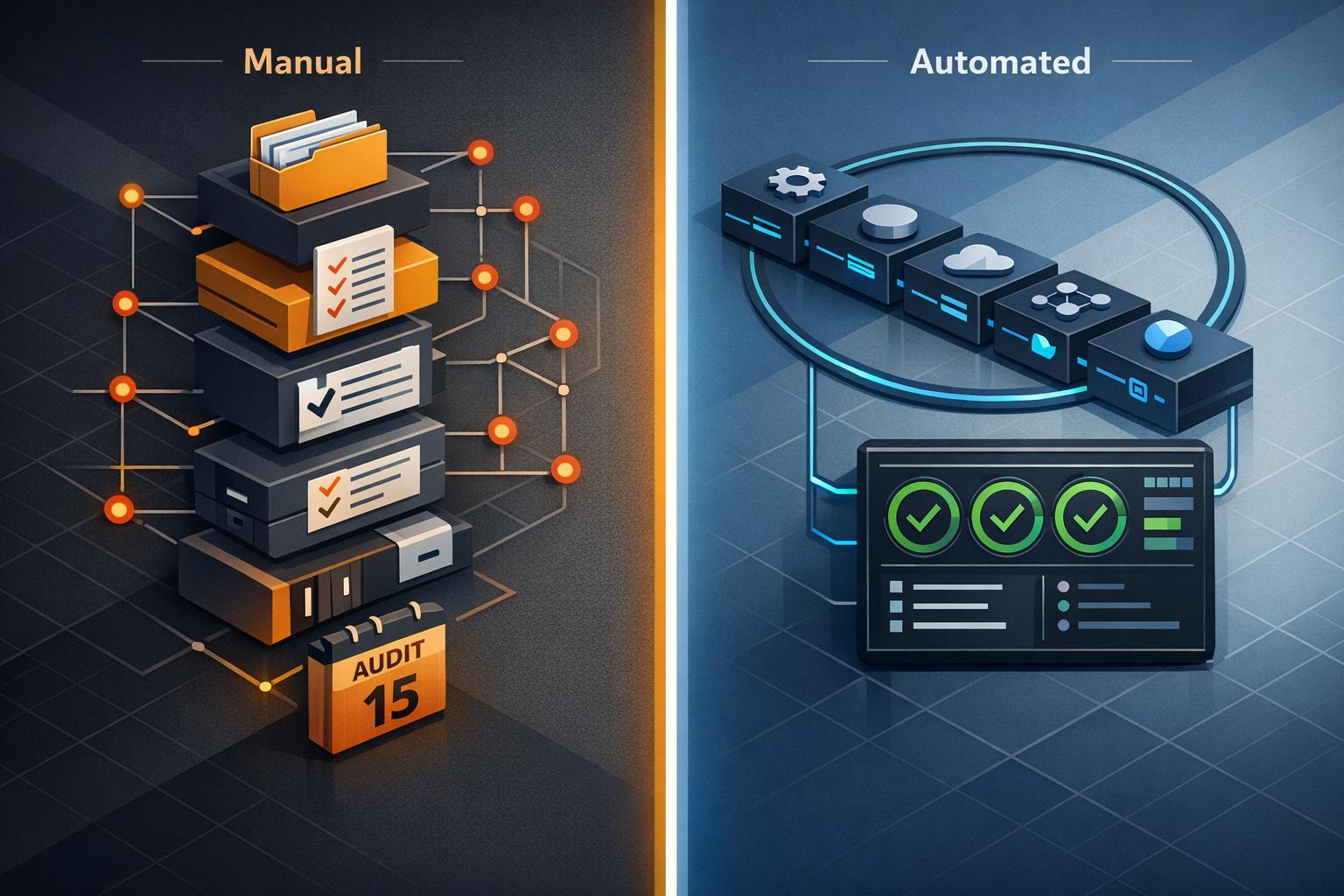
Manual evidence collection is outdated, slow, and error-prone. Automated evidence collection is faster, more accurate, and ensures continuous compliance.
Manual methods require compliance teams to spend hundreds of hours gathering logs, screenshots, and documents from various tools. This approach often leads to delays, incomplete evidence, and audit failures. In contrast, automated systems use APIs to collect data directly from source systems in real-time, reducing effort by up to 90% and improving audit readiness.
Key Takeaways
- Time Savings: Manual processes take 200–400 hours per audit cycle; automation reduces this to 20–40 hours.
- Cost Efficiency: Manual compliance costs ₹25–37 lakh annually, while automation costs ₹6–41 lakh.
- Error Reduction: 30–50% of manual evidence is flagged as incomplete; automation ensures high-quality, tamper-proof evidence.
- Scalability: Automation supports multiple compliance frameworks with a “collect once, use many” approach.
Conclusion: For modern compliance demands, automation is no longer optional. It saves time, reduces costs, and ensures organisations are always audit-ready.
Manual Evidence Collection: How it Works and Where it Falls Short
Standard Manual Evidence Collection Tasks
Manual evidence collection is a tedious process that eats into productivity. Compliance teams often have to log into platforms like AWS or Azure to take screenshots of system configurations, pull access logs from SSO providers like Okta, track down policy documents scattered across shared drives, and manually export data from various software tools. After gathering this evidence, they add timestamps, provide explanations, and map everything to specific controls - usually relying on spreadsheets to keep track of it all.
Auditors face their own set of challenges. They must identify trustworthy evidence sources, figure out whether evidence can be self-collected or requires stakeholder involvement, and send out detailed requests via email. For physical records, a secure chain of custody is essential. Preparing over 200 pieces of evidence can take up to three weeks, with the fragmented nature of these tasks stretching out the audit timeline.
Time and Resource Requirements
The time investment for manual evidence collection is immense. Even smaller organisations often spend 200–400 hours per audit cycle. For a single SOC 2 audit, manual preparation can take anywhere from 6 to 9 months. This translates to an opportunity cost of ₹33,00,000 to ₹66,00,000 in fully loaded personnel costs, as security teams are pulled away from their primary responsibilities to handle administrative tasks.
When organisations need to comply with multiple frameworks, the workload becomes unmanageable. Manual processes simply don’t scale, and the effort required increases dramatically with each additional framework. This is why manual evidence collection adds an extra 4–8 weeks to audit timelines, delaying crucial certifications.
Human Error and Inconsistency Risks
Beyond being time-intensive, manual evidence collection is prone to mistakes. Finding the right evidence can take longer than creating it. Practitioners spend 30 minutes per control just searching for files buried in email threads, Jira tickets, or shared drives. Even when evidence is located, it often lacks essential details like proper timestamps, explanations, or control mappings, forcing teams to redo the work.
The numbers paint a grim picture: auditors flag 30% to 50% of manually collected evidence as incomplete or unclear. This contributes to 20% to 30% of first-time SOC 2 audits failing due to insufficient evidence. Moreover, manual processes only offer a snapshot of compliance at a single point in time, leaving organisations unaware of their compliance status between audits. This can lead to last-minute scrambles when control failures are discovered during the audit, increasing the risk of penalties or reputational harm.
Switching between disconnected tools like email, spreadsheets, and task managers creates “log-in fatigue” for teams, resulting in coordination issues, data sync errors, and overall audit fatigue. These inefficiencies highlight the pressing need for automation to streamline the process and reduce the burden on compliance teams.
Automated Evidence Collection: How it Works and What it Delivers
The Mechanics of Automated Evidence Collection
Automated evidence collection connects directly to your existing technology stack using API integrations. Instead of manually logging into platforms like AWS, Azure, Okta, or Workday to capture screenshots or export data, this system automates the process. It pulls data from cloud providers, HRIS platforms, and identity providers, storing it in a centralised repository. This repository includes immutable audit trails and cryptographic timestamps, ensuring the data remains secure and reliable throughout the audit process.
One of the biggest shifts is moving from manual sampling to reviewing complete datasets. Traditional audits often rely on small samples - like 25 user accounts or a few change requests. Automation, on the other hand, allows auditors to examine entire datasets, uncovering patterns and anomalies that sampling might miss. Rule-based logic and AI tools then evaluate whether the collected data meets specific control requirements, such as confirming multi-factor authentication for all users or ensuring encryption at rest across databases. This approach eliminates the fragmentation and delays associated with manual methods.
Another key advantage is continuous monitoring. Instead of point-in-time assessments, automated scripts (e.g., daily cloud functions) create a structured, timestamped history of evidence that’s always up-to-date. The AICPA’s SAS 142 now explicitly acknowledges automated tools for evidence collection, marking a major step forward for tech-driven audit methodologies. These mechanisms deliver measurable improvements in time, cost, and data quality.
Primary Benefits of Automation
Automating evidence collection can reduce manual effort by as much as 90%, allowing security teams to focus on higher-priority tasks rather than repetitive administrative work. For organisations juggling multiple compliance frameworks, the efficiency boost is even more pronounced, with some audit firms reporting 30–50% faster processes.
Beyond efficiency, automation significantly improves the quality of evidence. It generates artefacts with immutable audit trails, timestamps, and detailed control mappings, which speeds up audit cycles. For example, Arbour Education managed to cut its audit preparation time from six weeks to just two weeks after adopting automated evidence collection in May 2025.
The financial benefits are just as striking. Manual evidence collection can cost organisations between ₹33,00,000 and ₹66,00,000 in security team time per audit. In contrast, automated solutions typically cost ₹12,50,000 to ₹41,50,000 annually. Currently, 53% of organisations dedicate at least one full-time employee solely to evidence collection.
Scaling Across Multiple Compliance Frameworks
Automation also simplifies scaling compliance efforts across multiple frameworks. Using a “collect once, use many” strategy, automated systems enable organisations to reuse evidence across overlapping standards. A unified control library maps one control to multiple frameworks. For example, enforcing multi-factor authentication can satisfy SOC 2 (CC6.1), ISO 27001 (A.5.15), and HIPAA (§164.312) simultaneously.
With automation, evidence for one control is automatically applied to all related requirements, enabling organisations to reuse up to 80–90% of controls across different frameworks. Advanced platforms also support dual tagging, where a single artefact - like a system configuration snapshot - can be tagged with multiple framework IDs. This eliminates redundant evidence collection for separate audits. AI tools further enhance this process by capturing application-level evidence, such as screenshots of internal admin panels, and tagging them with relevant framework IDs like CC8.1 and A.8.32.
When managing multiple certifications, the scalability of automation becomes evident. Manual processes require proportional increases in effort for each new framework, while automation provides real-time visibility into compliance across all frameworks. Currently, only 28% of organisations monitor security controls continuously, while 72% still rely on periodic assessments.
Manual vs Automated Evidence Collection: Side-by-Side Analysis
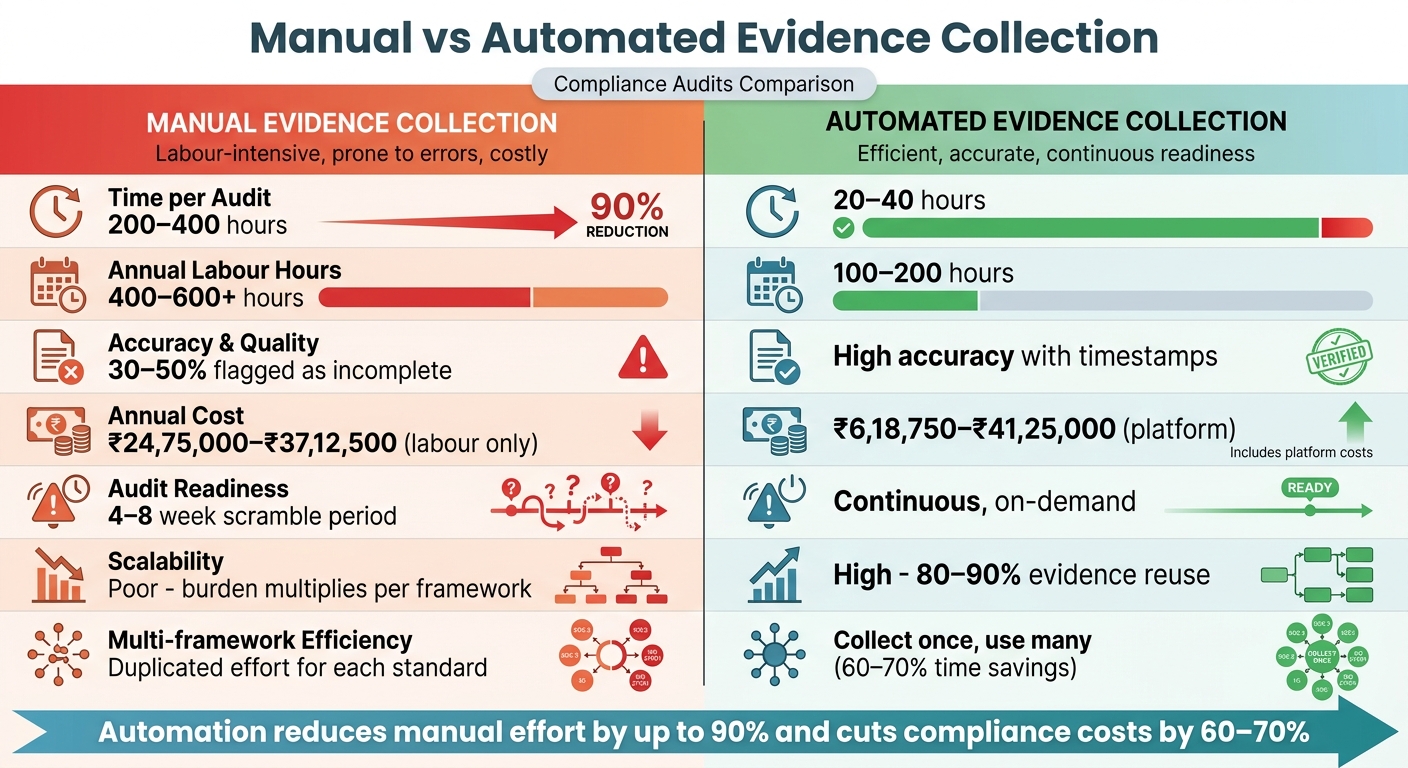
Manual vs Automated Evidence Collection: Time, Cost, and Accuracy Comparison
Building on the challenges and advantages previously discussed, let’s take a closer look at how manual and automated evidence collection stack up against each other.
Comparison Table: Manual vs Automated Methods
When you break it down, the contrast between manual and automated evidence collection is striking, especially in terms of time, accuracy, and scalability. For example, manual processes require 200–400 hours per audit cycle for small startups, while automation slashes this to just 20–40 hours. Annually, labour hours drop from 400–600+ hours to 100–200 hours.
Manual methods are not only time-consuming but also prone to errors, often leaving gaps in evidence. In contrast, automation solves these problems by pulling data directly from source systems via APIs. This approach ensures the evidence is reliable, complete, and comes with immutable timestamps and metadata.
| Feature | Manual Collection | Automated Collection |
|---|---|---|
| Time per Audit | 200–400 hours | 20–40 hours |
| Annual Labour | 400–600+ hours | 100–200 hours |
| Accuracy | High risk; 30–50% flagged as incomplete | High; direct from source with timestamps |
| Scalability | Poor; burden multiplies per framework | High; evidence reuse across frameworks |
| Audit Readiness | Periodic “scramble” lasting 4–8 weeks | Continuous, on-demand readiness |
| Evidence Quality | Often incomplete or unclear | Auditor-grade with metadata |
| Annual Cost | ₹24,75,000–₹37,12,500 (labour only) | ₹6,18,750–₹41,25,000+ (platform) |
| Multi-framework Efficiency | Duplicated effort for each standard | Cross-mapping; collect once, use many |
The cost difference is also worth noting. Manual compliance comes with a hefty price tag, ranging from ₹24,75,000 to ₹37,12,500 annually (based on 400–600 hours at ₹6,187.50/hour). Automated platforms, on the other hand, cost ₹6,18,750 to ₹41,25,000+ per year. For companies managing multiple compliance frameworks, automation can save 60% to 70% of the time.
Effect on Audit Results
The impact of automation goes beyond just numbers - it fundamentally changes audit outcomes. Manual methods often involve a frantic, last-minute rush to gather evidence. This reactive approach is stressful, with 65% of CISOs expressing significant concerns about compliance outcomes when relying on manual processes. Control failures frequently surface only when audits are underway.
“The most painful part of an audit is typically evidence gathering.” - Cyber Sierra Knowledge Team
Automation flips this script. Continuous monitoring ensures organisations are always audit-ready. Instead of relying on outdated, point-in-time snapshots, automated systems provide real-time control status updates. This allows companies to identify and fix issues before auditors even arrive. It’s no surprise that 76% of organisations using automation cut their monthly compliance tasks by half, and 53% accelerated their compliance timelines for multiple frameworks by 76% or more.
Automation also improves evidence quality, which speeds up audit cycles. Unlike manual methods that rely on sample data, automated systems collect complete datasets. This allows for population-level analysis that can uncover trends missed by manual sampling. With metadata like timestamps and source information included, auditors gain confidence and require fewer follow-ups. For instance, Arbour Education reduced its audit preparation time from six weeks to just two weeks after adopting automated evidence collection in May 2025.
For organisations juggling multiple frameworks, automation’s benefits multiply. Frameworks like ISO 27001 and SOC 2 share around 80% overlapping requirements. Automation platforms instantly map existing controls to new frameworks, enabling 80–90% of controls to be reused across standards. This “collect once, use many” approach eliminates the compounding workload that manual processes face when additional frameworks are added.
Practical Applications of Automated Evidence Collection
Automated evidence collection directly tackles the challenges that come with meeting compliance requirements across various frameworks. Let’s explore how this technology reshapes compliance efforts for SOC 2, ISO 27001, and multiple frameworks.
SOC 2 Compliance: Cutting Down Manual Work and Delays
SOC 2 audits are notorious for their extensive evidence requirements and lengthy preparation timelines. Typically, manual preparation takes anywhere from 6 to 9 months, and 83% of organisations report moderate to major delays due to manual compliance work.
Automation changes the game by slashing SOC 2 Type I readiness time to as little as 24 hours. How? By leveraging APIs to directly connect with cloud providers, HR systems, and security tools. These automated systems collect logs, user lists, and configurations, linking each piece of evidence to SOC 2 controls without needing human intervention. This approach significantly lowers the risk of audit failure, which happens in 20% to 30% of cases when evidence is incomplete.
Automation doesn’t just stop at SOC 2 - it also streamlines ISO 27001 compliance by simplifying documentation processes.
ISO 27001 compliance involves creating detailed documentation for an organisation’s Information Security Management System (ISMS), along with evidence for each Annex A control. Automated platforms simplify this by acting as a centralised hub - a single source of truth for all collected evidence. Data like MFA enforcement status, user provisioning logs, and vulnerability scan results are automatically captured, timestamped, and mapped to the relevant ISO 27001 controls.
These platforms also provide continuous monitoring, issuing real-time alerts to ensure compliance gaps are addressed promptly. This aligns perfectly with ISO 27001’s Plan-Do-Check-Act framework, making the compliance process much smoother.
Tackling Multiple Frameworks at Once
For organisations juggling multiple regulatory frameworks, the compliance workload can be overwhelming. Automation steps in to ease this burden through cross-framework mapping. For instance, a single piece of evidence - like a password policy or encryption configuration - can be applied to multiple standards at the same time. Many frameworks share common controls; for example, ISO 27001 and SOC 2 overlap on about 80% of their controls.
With automated tools, companies spend 82% less time on compliance tasks per framework. Teams that previously needed a full-time employee dedicated to evidence collection can now reallocate those resources to focus on strategic security initiatives.
Platforms like CISOGenie leverage AI-driven control mapping and continuous evidence collection to maintain audit readiness across all frameworks simultaneously. This ensures organisations stay compliant without overburdening their teams.
Implementing Automated Evidence Collection with CISOGenie
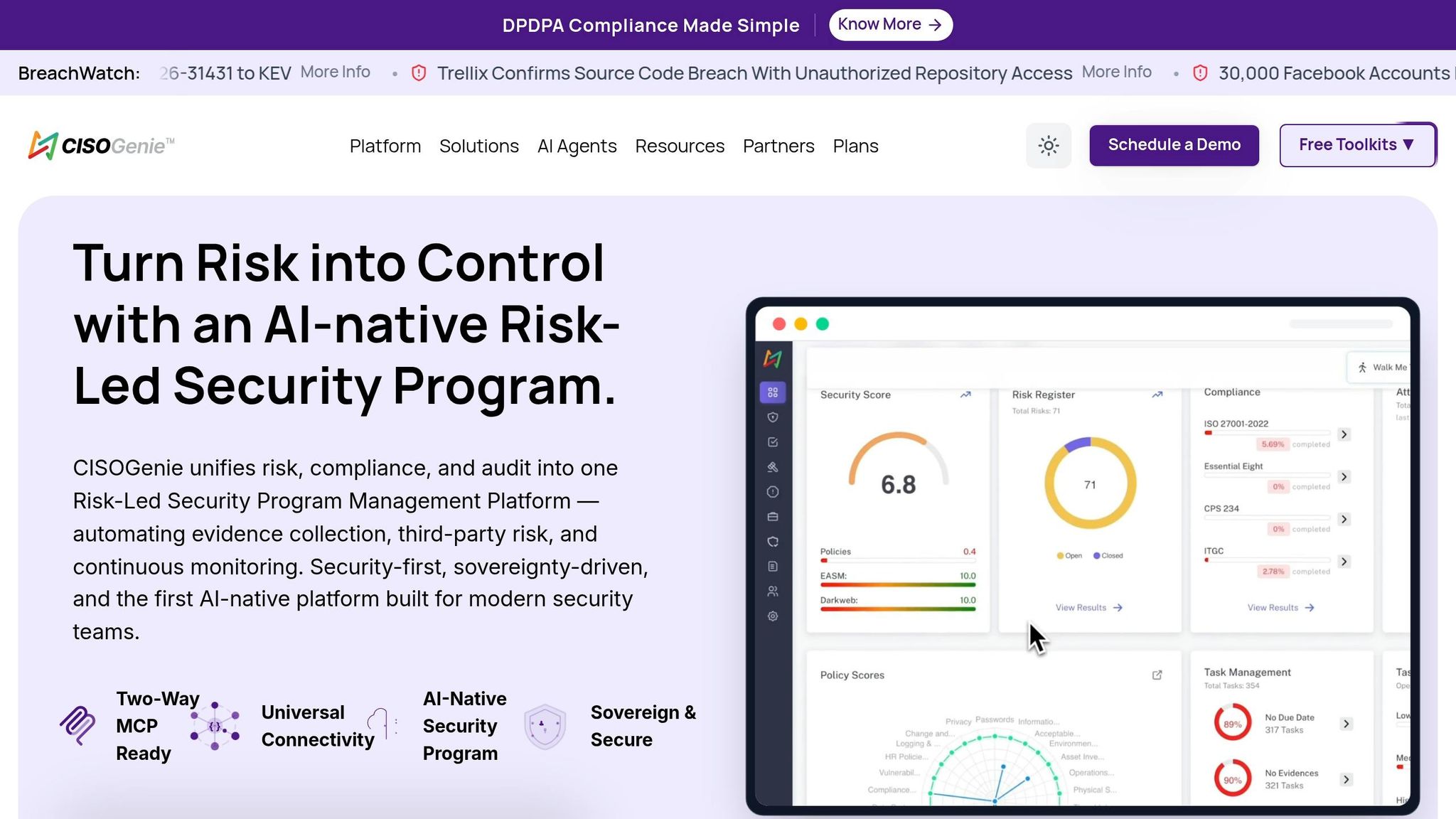
Implementation Steps
Switching from manual to automated evidence collection doesn’t require a complete overhaul of your existing systems. CISOGenie is designed to integrate seamlessly, ensuring minimal disruption while significantly improving compliance processes.
The journey begins with asset mapping. CISOGenie automatically identifies servers, databases, and applications, eliminating the risk of overlooked assets that often cause audit issues. Once the inventory is complete, the platform links your existing policies to specific framework controls using its library, which includes over 35 standards. These range from ISO 27001 and SOC 2 to India-specific regulations like SEBI CSCRF and RBI guidelines.
Next, automated checks are configured for key areas like MFA status, cloud storage access controls, and patching schedules. These checks can run as frequently as hourly, giving you real-time insight into your compliance status. A centralised dashboard displays control statuses, while automated alerts highlight issues, allowing quick fixes before they escalate into audit findings. All evidence is stored in a single, time-stamped repository, with one automated test often meeting multiple framework requirements simultaneously.
This structured approach not only simplifies compliance but also sets the foundation for tackling common challenges, which are explored further in the next section.
Solving Common Compliance Challenges
CISOGenie effectively addresses the common hurdles of traditional Governance, Risk, and Compliance (GRC) practices. Companies like Akasa Air, YouX, and DigiAlert have used the platform to achieve continuous compliance across IT and Operational Technology environments.
The platform’s “Implement Once” concept resolves the issue of fragmented systems. By identifying overlapping controls across frameworks, it eliminates the inefficiencies of siloed compliance efforts. This consolidation is a relief for teams overwhelmed by manual tasks and disjointed tools.
“CISOGenie’s Agentic AI platform is a game-changer for GRC. It moves beyond static checklists, using intelligent AI agents to create a proactive, dynamic defense that ensures complete data sovereignty.” - Shankar Jayaraman, Co-Founder and CEO, CISOGenie
Security concerns, particularly around credential management, are addressed through CISOGenie’s Zero Trust architecture. Unlike traditional platforms, it doesn’t store sensitive integration credentials, ensuring data sovereignty by keeping all information within your environment.
For vendor risk management, CISOGenie consolidates security data by combining internal risk metrics with external intelligence, such as dark web monitoring and automated vendor risk ratings. This unified approach reduces the need for multiple tools, allowing compliance teams to focus on managing strategic risks rather than administrative tasks.
Maintaining Continuous Compliance and Audit Readiness
CISOGenie’s continuous monitoring model ensures you’re always audit-ready, eliminating the “point-in-time” gaps that traditional compliance methods often leave behind. This proactive approach prevents the last-minute rush and compliance drift that many organisations face.
The platform’s AI agents deliver near real-time updates on control statuses, ensuring that failures are detected and addressed promptly. When controls fall out of compliance, automated alerts initiate remediation workflows, complete with clear accountability. This shift from reactive to proactive compliance management alleviates the stress reported by 65% of CISOs regarding compliance outcomes.
For organisations juggling multiple frameworks - nearly 70% of service organisations now manage compliance with at least six frameworks - CISOGenie’s unified mapping ensures that evidence collected once can be applied across all applicable standards. This efficiency reinforces the platform’s ability to streamline compliance processes across your regulatory requirements. Its “Sincere AI” approach ensures full transparency, with a detailed audit trail showing what evidence was collected, when, and from where.
For organisations with limited IT resources, implementation partners are available to provide support, ensuring audit readiness without the need for in-house specialists. Additionally, the platform’s multi-tenant architecture equips Managed Service Providers (MSPs) and Managed Security Service Providers (MSSPs) to deliver scalable compliance solutions to their clients.
“Our automation focuses on the most tedious tasks that consume a CISO’s time, such as evidence collection and control mapping, allowing them to focus on strategy.” - Shankar Jayaraman, Co-Founder and CEO, CISOGenie
Conclusion: The Case for Automated Evidence Collection
Key Points to Remember
Automation has revolutionised compliance processes, turning them from labour-intensive, reactive tasks into streamlined, continuous monitoring systems. Manual compliance methods often trap teams in a cycle of reactive work, consuming hundreds of hours annually and increasing the risk of errors and audit delays. In contrast, automation slashes these time demands, offering real-time visibility into control statuses and reducing manual efforts significantly.
The financial benefits are hard to ignore. Organisations relying on manual compliance face hidden labour costs between ₹25,00,000 and ₹37,50,000 annually. Automated platforms, on the other hand, can reduce time spent on compliance frameworks by 82%, while also minimising the risk of expensive penalties. With global regulators imposing over ₹59,000 crore in compliance-related fines in 2023 alone, the cost of not investing in automation far outweighs the upfront expense.
Beyond the numbers, automation alleviates the human burden of compliance work. A staggering 65% of CISOs report high stress levels stemming from compliance responsibilities, often due to last-minute manual efforts before audits. Automating repetitive tasks like screenshot collection and log analysis not only improves accuracy but also allows security teams to focus on higher-value, strategic initiatives. These benefits strengthen your organisation’s audit processes and support a robust, long-term compliance strategy.
Next Steps for Compliance Teams
The challenges of manual evidence collection make automation a critical step for achieving continuous compliance. Here’s how compliance teams can move forward:
- Assess Your Current Workload: If your organisation still relies on spreadsheets and manual methods, start by mapping out your compliance tasks. Identify the controls that demand the most time and pinpoint overlapping evidence requirements across frameworks like SOC 2 and ISO 27001. This exercise often highlights areas ripe for automation.
- Choose Continuous Compliance Solutions: Seek out platforms that go beyond periodic checks to offer real-time monitoring, cross-framework mapping, and AI-driven evidence collection. For example, CISOGenie’s platform combines Zero Trust architecture with advanced AI capabilities, supporting over 35 compliance frameworks while ensuring data sovereignty.
- Pilot and Scale Automation: Begin by automating high-volume technical controls, then expand automation efforts as you see results. This phased approach ensures a smooth transition while demonstrating the tangible benefits of automation.
FAQs
When should we automate evidence collection vs keep it manual?
When your goal is to boost efficiency, cut down on manual tasks, and maintain ongoing compliance - especially for frequent audits or frameworks like SOC 2 or ISO 27001 - automation is the way to go. It not only saves time but also reduces the risk of errors and allows for real-time monitoring of compliance efforts.
That said, manual evidence collection might still make sense for smaller, one-off audits with a narrow focus. In such cases, the cost and complexity of automation might not justify its use. However, for most organisations, automation helps streamline processes and avoid unnecessary delays.
How do automated tools ensure evidence is tamper-proof and auditor-acceptable?
Automated tools create secure, sequential digital audit trails that are designed to be tamper-proof and acceptable to auditors. These trails include strong controls over how evidence is collected, transported, stored, and accessed. This ensures the data remains verifiable and complies with auditor standards.
What’s a practical first step to automate SOC 2 or ISO 27001 evidence collection?
Creating a structured framework for evidence collection is a smart starting point. This framework should categorise evidence by control areas and link directly to relevant systems using APIs or integrations. By doing this, you can automate data collection - either continuously or on a set schedule - minimising manual work and cutting down on the time needed for audit preparation. Aligning this framework with audit requirements from the beginning ensures a more organised and efficient process.