7 Ways to Automate GRC Compliance Workflows
-
 Shankar Jayaraman
 - 23 Apr, 2026
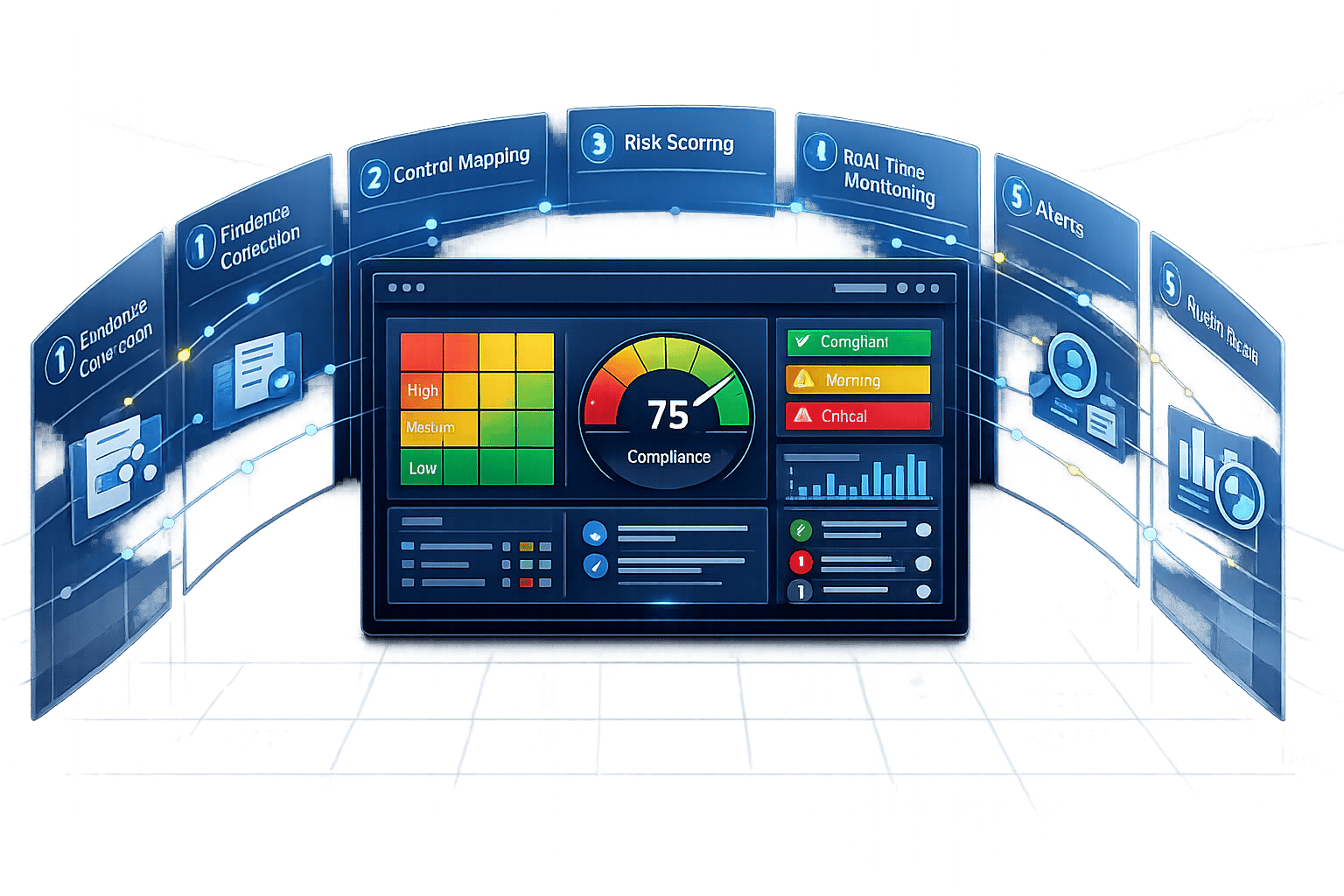
If you’re tired of manual compliance tasks and endless spreadsheets, automation can simplify your GRC (Governance, Risk, and Compliance) processes. By automating repetitive tasks like evidence collection and control validation, you can save up to 70% of your team’s time, reduce errors, and stay audit-ready year-round. Here’s how:
- AI-Driven Tools: Platforms like CISOGenie automate evidence collection, reduce compliance overhead by 50%, and cut audit preparation time by weeks.
- Pre-Built Templates: Ready-made compliance frameworks help you get started faster, reducing setup time by up to 75%.
- Unified Control Frameworks: Manage multiple frameworks (e.g., ISO 27001, SOC 2, GDPR) with a single control library.
- Real-Time Monitoring: Stay compliant daily with automated alerts and dashboards that flag issues immediately.
- Predictive Analytics: Anticipate risks and adjust controls proactively with AI-powered insights.
- Integrated Automation: Connect all your systems (AWS, Okta, Jira, etc.) for seamless compliance management.
Automation doesn’t just make compliance easier - it transforms it into a continuous, tech-driven process. Ready to leave manual workflows behind? Let’s dive into the details.
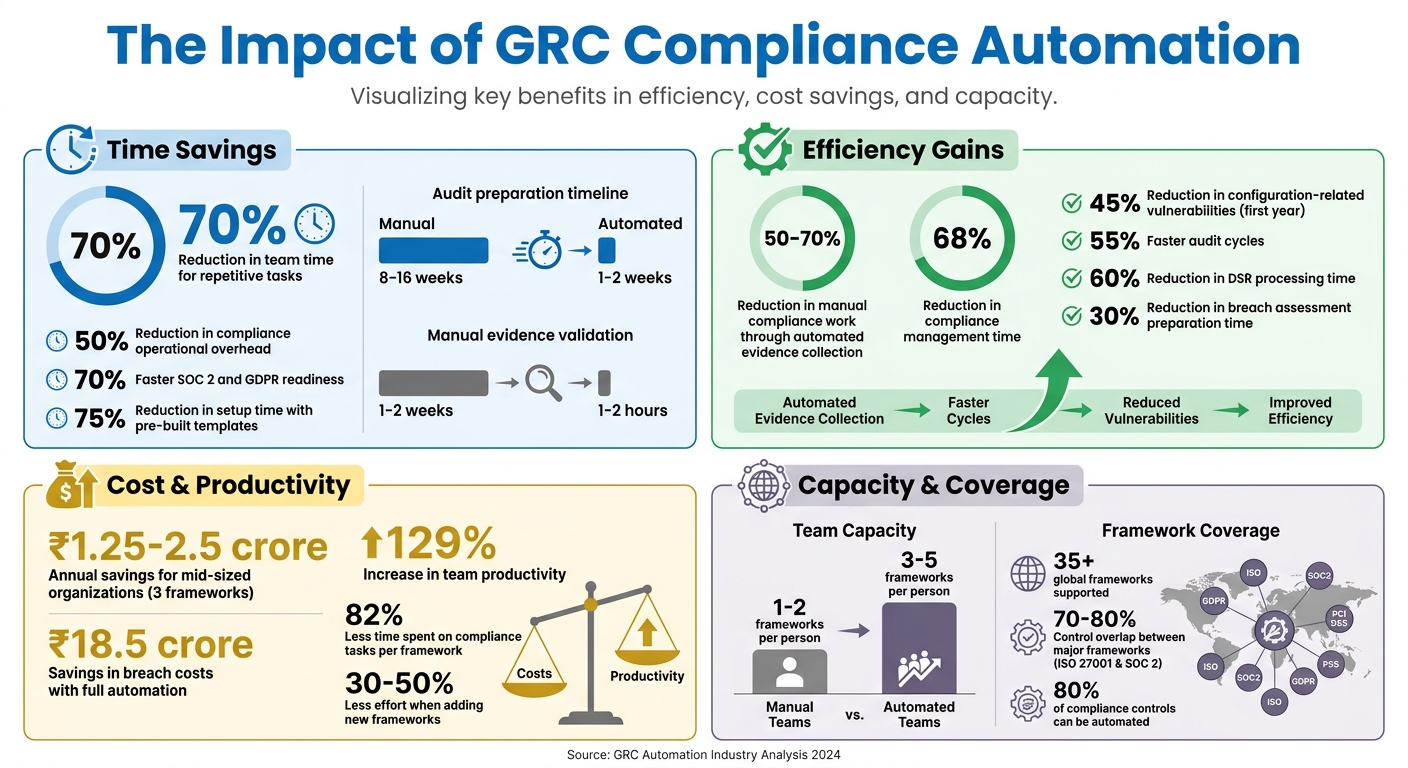
GRC Compliance Automation: Key Statistics and Time Savings
1. CISOGenie: AI-Powered GRC Compliance Automation
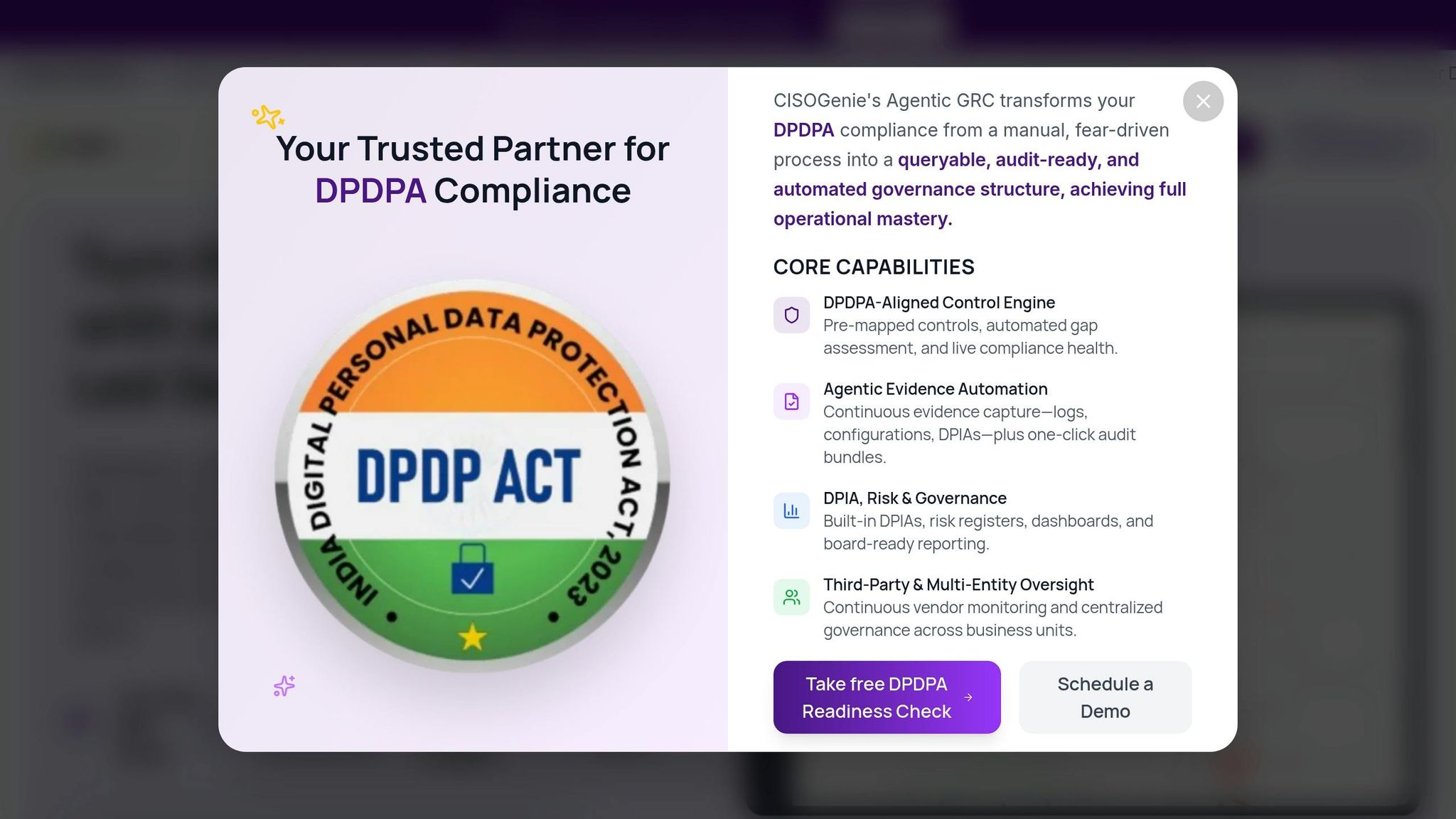
Automation Depth and Efficiency
CISOGenie takes traditional GRC processes and gives them a modern overhaul with autonomous “Agentic” workflows. These AI-driven agents operate locally, tapping directly into your cloud services, identity providers, or browsers to streamline compliance tasks.
The results are impressive. Tasks like manual evidence validation, which usually take 1–2 weeks, can now be completed in just 1–2 hours using this approach. The platform shifts from outdated, paper-based policies to machine-readable OSCAL artifacts, enabling automated validation across multiple frameworks. By eliminating repetitive tasks and cutting down on administrative work, organisations using CISOGenie have reported a 50% drop in compliance operational overhead. Additionally, achieving SOC 2 and GDPR readiness is up to 70% faster compared to traditional manual methods.
Framework Coverage and Multi-Framework Support
CISOGenie supports over 35 global and regional frameworks, including ISO 27001, SOC 2, GDPR, NIST CSF, and Indian regulations such as SEBI CSCRF, RBI guidelines, and the DPDPA (Digital Personal Data Protection Act). Its standout feature is the “Map Once. Comply Everywhere” approach, which leverages OSCAL standards to automatically adapt evidence for multiple frameworks simultaneously.
For example, a single MFA configuration can meet the requirements for ISO 27001, SOC 2, and GDPR without needing to reformat or duplicate evidence. Specific to GDPR, CISOGenie automates workflows like Record of Processing Activities (RoPA), data mapping, and handling Data Subject Requests (DSRs). This reduces the time spent on DSRs by 60%. The platform also includes a Breach Response Centre equipped with pre-built workflows for 72-hour notifications, cutting breach assessment preparation time by 30%. These features make it a scalable and flexible solution for diverse IT setups.
Scalability and Integration Capabilities
The platform operates on a “Zero Trust Sovereignty” model, where lightweight AI agents run locally within your systems or browser. This ensures that sensitive credentials, such as API keys and passwords, never leave your environment.
“We directly address the CISO’s primary fear by not storing client credentials on our platform.” - Shankar Jayaraman, Co-Founder and CEO, CISOGenie
This agent-based design is not only more secure but also more resilient compared to traditional API integrations, which often break with system updates. It’s versatile enough to cater to startups and large enterprises with complex data needs. Additionally, it’s white-label ready, making it an ideal choice for MSPs, MSSPs, and vCISOs looking to deliver compliance services to multiple clients. Organisations like Akasa Air, YouX, and DigiAlert have already adopted CISOGenie to automate evidence collection and reporting across IT and Operational Technology (OT) environments.
Real-Time Monitoring and Predictive Capabilities
CISOGenie doesn’t just stop at automation - it also provides real-time monitoring and predictive analytics. By combining internal risk data with external intelligence, such as dark web monitoring and attack surface management, the platform offers a comprehensive view of your security landscape.
The goal is “predictive compliance” - anticipating regulatory changes and risks before they become issues. With continuous monitoring and AI agents working around the clock, you’re not just audit-ready; you gain daily insights into your security posture. This shift from periodic checks to ongoing assurance is key for modern GRC management.
2. Pre-Built Compliance Templates for Faster Setup
Pre-built compliance templates are a game-changer when it comes to simplifying GRC (Governance, Risk, and Compliance) processes. These templates, combined with AI-powered workflows, make it easier to kickstart compliance programmes and manage them efficiently.
Automation Depth and Efficiency
Starting a compliance programme from scratch can feel overwhelming - imagine staring at a blank spreadsheet filled with control requirements. Pre-built templates solve this issue by offering pre-populated control libraries. These libraries outline specific control requirements and seamlessly integrate with your existing tools.
Here’s the time-saving potential: manual audit preparation can take anywhere from 8 to 16 weeks. With pre-built templates, you can get SOC 2 ready up to 70% faster and cut overall compliance time by up to 75%.
“Rather than starting with a blank spreadsheet and 93 rows, you start with a structured assessment that already understands what each control requires and can suggest how your existing tools and processes might satisfy it.” - SecPortal
This structured approach not only saves time but also ensures greater accuracy, setting the stage for effective multi-framework compliance.
Framework Coverage and Multi-Framework Support
Modern compliance templates are designed to support a wide range of standards, including SOC 2, ISO 27001, GDPR, HIPAA, PCI-DSS, NIST CSF, and Cyber Essentials. But the real magic lies in cross-framework mapping. This feature allows evidence collected for one standard to automatically meet overlapping requirements in others.
For example, if your organisation already holds ISO 27001 certification, you’ve likely covered 70% to 80% of the requirements for another framework through shared controls. That means you only need to address the remaining 20–30% of unique controls. Additionally, these templates make gap analysis easier by highlighting which parts of your existing setup already comply with specific frameworks. This way, your team can focus on filling the gaps instead of starting from scratch.
3. Unified Control Frameworks for Multi-Framework Compliance
A unified control framework is a game-changer when it comes to simplifying the often fragmented processes of compliance. After exploring automation and pre-built templates, this approach takes things a step further by streamlining control systems under one roof.
Framework Coverage and Multi-Framework Support
Managing separate control sets for ISO 27001, SOC 2, GDPR, and PCI DSS can lead to unnecessary duplication. A unified control library eliminates this by maintaining a central repository. For example, a single control like Multi-Factor Authentication can be mapped to meet the requirements of multiple frameworks simultaneously. This means one implementation and one piece of evidence can satisfy overlapping requirements for ISO 27001, SOC 2, PCI DSS, NIST CSF, and GDPR.
The overlap between frameworks is significant. ISO 27001 and SOC 2, for instance, share nearly 80% of their control requirements. By using an automated platform, organisations only need to address the remaining 20–30% of unique controls when adding a new framework. This approach slashes additional compliance efforts by as much as 30–50%. The result? Less redundancy and a more efficient compliance process.
Automation Depth and Efficiency
Automation takes this unified approach even further by integrating with key systems like AWS, Azure, Okta, and HR platforms. These integrations automatically extract detailed evidence, reducing manual workloads by 50–70%. This efficiency allows GRC teams to manage 3 to 5 frameworks per person, compared to just 1 to 2 frameworks in manual setups. For a mid-sized organisation, automating three frameworks can result in annual cost savings ranging from ₹1.25 crore to ₹2.5 crore.
“Compliance automation does not remove the need for security expertise. It frees security professionals to focus on improving controls rather than documenting them.” - SecPortal
Automation also minimises human error, which accounts for over 60% of audit findings in manual environments. By using timestamped and immutable evidence collection, organisations can significantly enhance the accuracy of their compliance processes.
Scalability and Integration Capabilities
Unified frameworks also offer unmatched scalability. With Continuous Controls Monitoring (CCM), compliance evolves from periodic audits to real-time oversight, identifying control issues within hours instead of months. Automated platforms make it possible to achieve audit readiness for ISO 27001 or SOC 2 in less than 12 weeks, whereas manual processes can take 9–12 months.
Currently, 92% of organisations rely on three or more tools just to gather audit evidence. This creates inefficiencies and data silos. A well-integrated unified framework eliminates these barriers, ensuring that new frameworks can be added without requiring additional tools or manual effort. This streamlined approach not only saves time but also sets the stage for long-term compliance success.
4. Real-Time Monitoring and Automated Alerts
Real-time monitoring takes compliance management to the next level by keeping your organisation’s compliance status up to date at all times. Instead of uncovering issues months later, automated systems can detect security drifts within hours or days, enabling faster detection and resolution of compliance challenges.
Real-Time Monitoring and Predictive Capabilities
Automated alerts - whether through email or platforms like Slack - notify teams immediately when a compliance threshold is breached, a control fails, or a configuration changes unexpectedly. For example, if encryption is accidentally turned off on a database or a former employee still has system access, the system flags these issues right away. By maintaining audit-ready logs around the clock, these tools bridge the gap between preparation and the specific needs of auditors.
The benefits of automation are clear. Organisations using GRC tools reduce compliance management time by up to 68%. Automated control validation can cut configuration-related vulnerabilities by 45% in just the first year. AI-powered validation further speeds up the process, reducing evidence review timelines from weeks to just hours.
“A lot of audits are point-in-time, but these integrations give you insight throughout the year.” - Elise Spitzer, Thoropass
Automation Depth and Efficiency
With a centralised dashboard, IT leaders can monitor compliance status in real time without juggling multiple tools or spreadsheets. API-first systems pull live data from cloud platforms like AWS, Azure, and GCP, identity providers such as Okta and Azure AD, and security tools like CrowdStrike and Splunk. This ensures that evidence is always up to date. When a control fails, remediation tickets are automatically created in tools like Jira or ServiceNow and tracked until resolved.
The efficiency gains are significant. Organisations using automated audit tools experience a 55% faster audit cycle on average. Additionally, 53% of compliance professionals report that such technology helps them identify and fix issues more quickly, reducing the need for last-minute corrections. For businesses managing multiple frameworks, real-time monitoring ensures that a single piece of evidence - like proof of MFA implementation - can satisfy overlapping requirements across standards such as SOC 2, ISO 27001, NIST CSF, and PCI DSS.
Scalability and Integration Capabilities
Real-time monitoring extends beyond internal controls to address external risks as well. These systems can process signals like security breach notifications, changes in credit ratings, and mentions on the dark web to update vendor risk scores dynamically. This is critical, especially as third-party breaches have doubled from 15% to 30% in a single year. Additionally, modern platforms track regulatory updates across frameworks like the EU AI Act, GDPR, and SEC mandates. They perform impact analyses to pinpoint potential compliance gaps before they escalate into audit issues. This continuous oversight sets the stage for streamlined evidence collection and comprehensive audit trail management.
5. AI-Driven Evidence Collection and Audit Trail Management
AI-powered tools take real-time monitoring a step further by ensuring that every compliance action is recorded precisely and securely.
Collecting evidence manually can be a tedious process - capturing screenshots, exporting logs, and gathering proof of compliance often eats up valuable time. AI-driven automation solves this issue by pulling evidence directly from your infrastructure via API integrations. It creates timestamped and tamper-proof records without requiring human input. This means your team can shift its focus from repetitive tasks to more impactful work, like analysing and addressing strategic risks, instead of spending weeks preparing for audits.
Automation Depth and Efficiency
AI tools simplify compliance tasks by automatically capturing screenshots, generating reports, and validating evidence against pre-set policies. For instance, consider manually reviewing access lists across 20 systems - a task that usually takes 40–80 hours each quarter. With automated workflows, this effort is reduced to just 8–12 hours, while still producing a comprehensive audit trail. In fact, automated evidence collection can cut manual compliance work by 50–70%, and organisations using these systems report slashing audit preparation time from 8–16 weeks down to just 1–2 weeks.
Take Tines, for example. In 2024, the company achieved SOC 2 compliance in just four months by automating evidence collection for endpoint compliance and tracking over 7,000 code merges in GitHub. This saved them over 250 hours of manual IT and engineering work. Similarly, PathAI replaced manual YAML and Python workflows with automated onboarding processes, saving 45 minutes per request while generating audit-ready records in Jira.
Beyond simply saving time, AI tools extend these efficiencies across multiple compliance frameworks.
Framework Coverage and Multi-Framework Support
AI simplifies compliance across various frameworks by letting you “test once, comply with many.” For example, evidence of MFA implementation can automatically be applied to frameworks like ISO 27001, SOC 2, HIPAA, and GDPR. When new regulations emerge, AI analyses their requirements and matches them to existing controls, often with confidence scores, reducing what would take weeks of manual work into just a few hours. This is particularly valuable, as nearly half of GRC teams - 48% - struggle to keep up with updates to existing frameworks.
When paired with real-time alerts, AI-driven evidence collection becomes a key component of a continuous compliance strategy.
Scalability and Integration Capabilities
Modern platforms take this efficiency further by integrating seamlessly with your existing SaaS tools.
Through deep API integrations, these platforms connect with tools like AWS, Okta, GitHub, and Datadog to extract detailed evidence without requiring custom scripts. AI-powered auto-discovery maps over 50 common integrations directly to specific control requirements. This transforms compliance from a periodic, “snapshot” approach into a continuous process where evidence is collected daily or even hourly, and controls are monitored in real time.
“Automated evidence collection is the highest-ROI GRC automation investment, drastically reducing manual effort.” - FortisEU
6. Predictive Analytics for Compliance Risk Management
Building on the foundation of automated evidence capture, predictive analytics gives organisations the tools to anticipate risks and adjust controls proactively.
Real-Time Monitoring and Predictive Capabilities
Traditional GRC practices, like quarterly risk assessments, often become outdated quickly. Predictive analytics, on the other hand, works in real-time, recalculating risk exposure based on live signals such as commodity price fluctuations, cyber incidents, or geopolitical shifts. This shift changes the question from “Were we compliant last quarter?” to “Are we compliant right now?”. With 94% of InfoSec leaders confident that Continuous Controls Monitoring will enhance both compliance and security by 2025, the industry is clearly moving toward a model of ongoing assurance. In this model, AI agents evaluate control performance daily, identifying risks before they escalate. This continuous recalibration feeds into real-time risk scoring, offering a dynamic view of compliance.
By incorporating live data feeds, predictive analytics strengthens the proactive edge of automated compliance systems. These systems pull in data from sources like vulnerability scans, threat intelligence, and vendor updates to keep risk scores current. They also prioritise remediation based on the organisation’s context. For instance, AI models can analyse code commit histories or spot unusual transaction patterns, flagging potential threats early so teams can act quickly. Financially, the benefits are clear - organisations fully utilising automation for data protection save nearly ₹18.5 crore in breach costs compared to those without such systems.
Framework Coverage and Multi-Framework Support
In environments where multiple compliance frameworks are in play, predictive analytics shines by employing “digital twins.” These digital models simulate the impact of strategic decisions on compliance across frameworks like ISO 27001, SOC 2, and GDPR simultaneously. AI-powered systems can interpret multiple frameworks and map overlapping requirements into a unified control set. This allows organisations to predict how a single control failure might affect compliance across all frameworks.
When new regulations are introduced, AI-driven regulatory agents monitor hundreds of global rulemaking bodies, forecasting how these changes will impact internal policies and control gaps. This approach goes beyond simple evidence mapping, offering strategic insights into compliance posture.
“Agentic AI moves GRC beyond task automation into collaborative, decision-shaping intelligence embedded across compliance, risk, audit, and ESG functions.”
— Michael Rasmussen, GRC Analyst
Automation Depth and Efficiency
Predictive analytics doesn’t just identify risks - it also boosts team efficiency. Compliance teams leveraging automation are, on average, 129% more productive. AI-driven tools can cut audit preparation time by up to 70%, and companies using automated compliance systems spend 82% less time on compliance tasks per framework. These tools also recommend customised control sets tailored to an organisation’s industry, size, and risk profile, ensuring resources are focused where they’re needed most.
This efficiency is particularly valuable when nearly half (46%) of security leaders cite increasing regulatory complexity as a major source of stress and burnout. Predictive analytics helps alleviate this burden by enabling a risk-based, adaptive approach to compliance management.
7. Integrated Automation Across Multiple Systems
Scalability and Integration Capabilities
Integrated automation brings all your technology systems - like cloud infrastructure, identity platforms, HR tools, and development solutions - into a single compliance engine. This approach eliminates data silos, which nearly 46% of security leaders say add to operational stress.
By leveraging deep API connections with platforms like AWS, Azure, Okta, Workday, GitHub, and Jira, these systems can automatically collect detailed, timestamped evidence. Take PathAI as an example: they replaced a cumbersome manual onboarding process with an automated workflow. This system validated new hires, assigned access, and logged actions in Jira, saving 45 minutes per onboarding request while ensuring audit-ready records. Such seamless integration also enables unified control mapping across compliance frameworks.
Framework Coverage and Multi-Framework Support
Integrated automation doesn’t stop at connectivity; it simplifies compliance across multiple frameworks. For instance, a single control - like multi-factor authentication - can simultaneously meet requirements for SOC 2, ISO 27001, and HIPAA. With this unified control library approach, organisations adopting new frameworks experience 30% to 50% less additional effort compared to their initial implementation. Automated teams can manage 3 to 5 compliance frameworks per person, whereas manual teams typically handle only 1 to 2 frameworks.
Automation Depth and Efficiency
When integration is combined with real-time monitoring, it creates a cohesive, risk-focused compliance strategy. This deep integration delivers measurable results. For example, Druva’s security team automated repetitive tasks like Jira queries and compliance checks, saving each analyst 1 to 2 hours per week.
AI-driven GRC platforms can automate up to 80% of compliance controls. Organisations using continuous automation have cut audit preparation times from the usual 8 to 16 weeks down to just 1 to 2 weeks, while also reducing compliance costs by as much as 40%.
CISOGenie’s AI-native platform is a great example of this approach. It connects autonomous agents across your tech stack to enable continuous monitoring, automated evidence collection, and real-time risk dashboards. At the same time, it ensures data sovereignty through its Zero Trust architecture. By integrating diverse systems into one compliance engine, organisations achieve a comprehensive GRC posture that’s prepared for emerging risks.
How to Prepare for GRC Automation
To ensure a smooth transition to GRC automation, it’s crucial to start by thoroughly analysing your current workflows.
Before diving into automation, map out your existing workflows from start to finish. Document every manual step, team handoff, and tool involved in your GRC processes. Use employee surveys and team meetings to identify duplicated efforts or communication breakdowns. Establish a baseline by measuring the time and costs spent on tasks like evidence collection and risk assessments. This baseline will help you calculate the return on investment (ROI) once automation is in place.
Once you have this baseline, focus on identifying areas where automation will have the greatest impact. Target high-value processes that consume significant time and effort. Evidence collection, for example, often accounts for 70% to 80% of compliance work, making it a prime candidate for automation. Look for repetitive, high-volume tasks such as access reviews, endpoint compliance checks, and vulnerability scan consolidations. Pay special attention to processes that cause “audit fatigue”, as these tend to involve manual work that adds little strategic value.
When evaluating automation tools, prioritise integration and framework compatibility. Choose platforms that integrate seamlessly with your existing tech stack, including cloud providers, identity management systems, HR tools, and security software. The tools should also support current and future compliance frameworks - like ISO 27001, SOC 2, NIS2, and GDPR - through a unified control library that allows one piece of evidence to fulfil multiple requirements. Automated evidence should be audit-ready, meaning it must be timestamped, tamper-proof, and formatted for easy auditor review.
Adopt a phased implementation strategy to roll out automation effectively. Start small by replacing spreadsheet-based risk registers (Crawl). Then, automate evidence collection for your top 20 high-impact controls (Walk). Finally, scale up to full workflow automation and AI-driven analytics (Run). Before declaring a control “automated”, validate its outputs against manual checks through a complete review cycle.
To secure leadership approval, present ROI metrics based on time and cost savings, as well as risk reduction. Highlight potential savings from avoiding fines under frameworks like GDPR or NIS2, where penalties can reach EUR 10 million or 2% of global annual turnover for essential entities. Studies show that 93% of compliance teams find AI and cloud-based tools more effective at reducing human error compared to manual processes.
Conclusion
Automating GRC compliance workflows has become a game-changer in navigating today’s intricate regulatory environment. Transitioning from tedious, spreadsheet-driven processes to AI-powered automation slashes manual effort and shortens audit preparation timelines from weeks to just a few days. This shift also transforms compliance from periodic checks to ongoing assurance, ensuring that your controls are effective every single day - not just during audit season.
By using unified control frameworks, organisations can streamline compliance efforts. For instance, a single policy like MFA can satisfy multiple regulatory standards, cutting down on redundant documentation and saving both time and money. Real-time dashboards further enhance this process by offering instant insights into compliance health, reducing audit fatigue and making risk management more proactive and efficient.
“Compliance automation isn’t just about passing audits faster. It’s about building systems that are secure by default and can prove it at any moment.” - GyanByte
To get started, focus on high-impact areas like access reviews and endpoint compliance. Validate initial results through manual checks and expand automation gradually. This approach not only frees your team from repetitive tasks but also allows them to concentrate on strategic risk management. By adopting AI-driven automation and prioritising high-value controls, organisations can foster a compliance culture that stays resilient and ready to tackle evolving challenges.
FAQs
What should we automate first in GRC to see ROI quickly?
To see a faster return on investment (ROI) in GRC automation, focus first on automating evidence collection. This step can cut down 50-70% of the manual work involved in compliance, reduce the chances of errors, and speed up audit preparation. By automating evidence collection, compliance becomes a smoother, ongoing process. It not only delivers immediate benefits but also sets the stage for automating other areas like controls, risk assessments, and reporting.
How can we maintain continuous compliance without causing alert fatigue?
To maintain ongoing compliance without being overwhelmed by constant notifications, it’s essential to embrace automated monitoring and real-time dashboards that filter out unnecessary alerts and highlight only what truly matters. Begin with a crawl-walk-run strategy, which allows you to gradually integrate automation into your processes.
Leverage AI-powered tools, such as predictive analytics, to rank alerts based on their risk level. This approach cuts down on alert overload and ensures your team focuses on the most critical issues. Prioritise areas like automated evidence collection, real-time control monitoring, and risk-based alert management to streamline operations while keeping excessive notifications in check.
How can one set of evidence satisfy SOC 2, ISO 27001, and GDPR?
Using automated compliance tools, a single set of evidence can meet the requirements for SOC 2, ISO 27001, and GDPR. These tools simplify the process by mapping controls across frameworks, centralising policies, and automating evidence collection. They also enable continuous monitoring, ensuring compliance stays current. Since these frameworks often have overlapping requirements, unified evidence can streamline efforts, minimise manual work, and keep everything audit-ready across multiple standards.