What is OSCAL and Why It's the Future of Compliance Automation
-
 Balachandran Sivakumar
 - 07 May, 2026
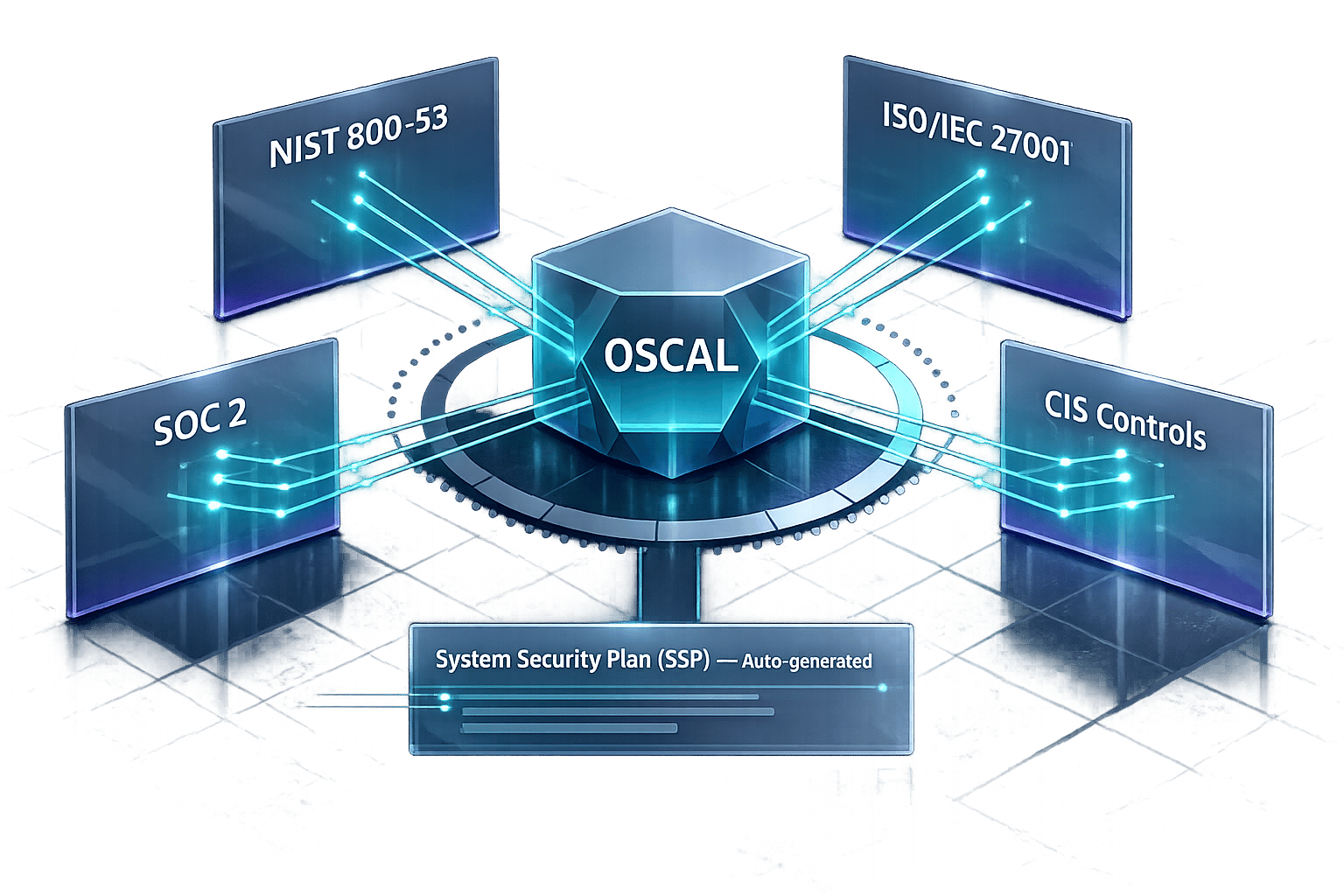
OSCAL (Open Security Controls Assessment Language) is a standard developed by NIST to simplify and automate compliance processes. It replaces outdated, manual documentation formats like Word and Excel with machine-readable formats such as JSON, XML, and YAML. This allows organisations to automate compliance tasks, reduce errors, and map controls across multiple frameworks like ISO 27001, SOC 2, and GDPR.
Key Highlights
- “Map Once, Comply Many”: Document controls once and apply them across multiple frameworks.
- Automation: Speeds up processes like creating System Security Plans (SSPs) and Security Assessment Plans (SAPs).
- Continuous Monitoring: Enables real-time compliance tracking instead of outdated, point-in-time snapshots.
- Adoption Deadline: FedRAMP mandates OSCAL adoption by 30th September 2026 for new authorisation packages.
Benefits
- Cuts audit preparation time from weeks to days.
- Reduces manual errors through automated validation.
- Simplifies multi-framework compliance by creating a single source of truth.
- Supports ongoing compliance monitoring with real-time updates.
Organisations like AWS, Google, and federal agencies are already leveraging OSCAL to reduce compliance timelines and improve efficiency. Tools like CISOGenie integrate OSCAL with AI, further automating evidence collection and documentation. As regulatory demands grow, OSCAL is becoming a critical tool for managing compliance at scale.
How OSCAL Benefits Compliance Teams
By leveraging OSCAL’s ability to simplify and modernise compliance processes, teams can streamline their workflows, bridge gaps between frameworks, and enable real-time monitoring. Let’s explore three main ways OSCAL delivers value: automating documentation, achieving cross-framework compliance, and enabling continuous monitoring.
Automating Compliance Documentation
OSCAL takes the hassle out of repetitive manual tasks. Instead of relying on static Word documents or Excel sheets, it uses machine-readable formats like JSON, XML, and YAML. These formats allow computers to automatically parse, validate, and process data. This means compliance teams can programmatically generate key documents - such as System Security Plans (SSPs), Security Assessment Plans (SAPs), Security Assessment Results (SARs), and Plans of Action and Milestones (POA&Ms) - without needing to rewrite them manually.
“Let the machine do the hard work so the human can do the nuanced work they need to do to manage risk.”
Rather than spending weeks on formatting and narratives, teams can redirect their energy towards making informed risk management decisions.
“OSCAL changes the daily grind from formatting narratives to managing data.”
Another game-changer is component reusability. Organisations can create “Component Definitions” for specific tools or services and reuse them across multiple systems. This eliminates the need to rewrite implementation details every time a new authorisation is needed.
Cross-Framework Interoperability
OSCAL’s “map once, comply many” philosophy streamlines cross-framework compliance. Instead of manually mapping controls between frameworks like NIST 800-53, ISO 27001, SOC 2, and HIPAA, OSCAL standardises how controls are represented across these frameworks.
For instance, if an organisation documents its access control implementation for NIST 800-53, OSCAL can automatically map that implementation to equivalent requirements in ISO 27001 and SOC 2.
Here’s how OSCAL layers contribute to interoperability:
| OSCAL Layer | Role in Interoperability |
|---|---|
| Catalogue Layer | Provides standardised control definitions (e.g., NIST 800-53) across frameworks |
| Profile Layer | Customises and selects controls to create specific baselines (e.g., FedRAMP, CMMC) |
| Component Layer | Offers reusable descriptions of how tools or services implement controls |
| Implementation Layer | Documents the system’s security posture (e.g., SSP) in a machine-readable format |
Continuous Monitoring and Real-Time Assessments
Traditional compliance often relies on point-in-time snapshots, where auditors review documentation that may already be outdated. OSCAL flips this model by enabling continuous assurance, allowing teams to evaluate control effectiveness on an ongoing basis.
With the OSCAL Assessment Layer - particularly the Assessment Results and POA&M models - findings can be documented in machine-readable formats. For example, when an automated security scan identifies a vulnerability, it can be tracked, remediated, and reported to stakeholders without manual effort.
This shift from reactive compliance to proactive risk management is reshaping how organisations handle regulatory requirements.
Using OSCAL for Multi-Framework Compliance
OSCAL is transforming how organisations handle compliance across multiple regulatory frameworks by simplifying and streamlining the process. For businesses juggling requirements from frameworks like ISO 27001, SOC 2, GDPR, and FedRAMP, redundancy in documentation and effort has always been a major challenge.
Mapping OSCAL to Common Frameworks
One of OSCAL’s strengths is its ability to map controls across different frameworks, reducing repetitive manual work. Its layered structure plays a key role in this.
A practical example is AWS using OSCAL to support both U.S. and Canadian security profile mapping by reusing NIST control definitions and applying profile modifications.
For organisations managing multiple frameworks, OSCAL enables a smarter approach: document once and reuse control implementations across framework-equivalent requirements.
Automating SSPs and SAPs
OSCAL doesn’t just simplify compliance - it automates it. Traditionally, creating System Security Plans (SSPs) and Security Assessment Plans (SAPs) has been labor-intensive. With OSCAL’s machine-readable formats, this workload is drastically reduced.
The automation process follows a clear hierarchy:
- Controls are defined in the Catalogue Layer.
- Controls are customised in the Profile Layer.
- Implementation details are described in the Component Layer.
- The SSP is generated automatically.
This structured approach supports compliance-as-code workflows and CI/CD-based validation.
Faster Audit Readiness with OSCAL
OSCAL also revolutionises audit readiness by enabling continuous evidence collection. Through its Assessment Results model, OSCAL standardises how findings, observations, and risks are documented.
Automated validation tools check OSCAL documents for schema compliance, reducing formatting errors and missing control gaps before audit review.
For teams managing multiple frameworks, OSCAL enables a single source of truth for security posture. Framework-specific reports for ISO 27001, SOC 2, or GDPR can be generated quickly instead of rebuilt manually.
How OSCAL Solves Compliance Challenges
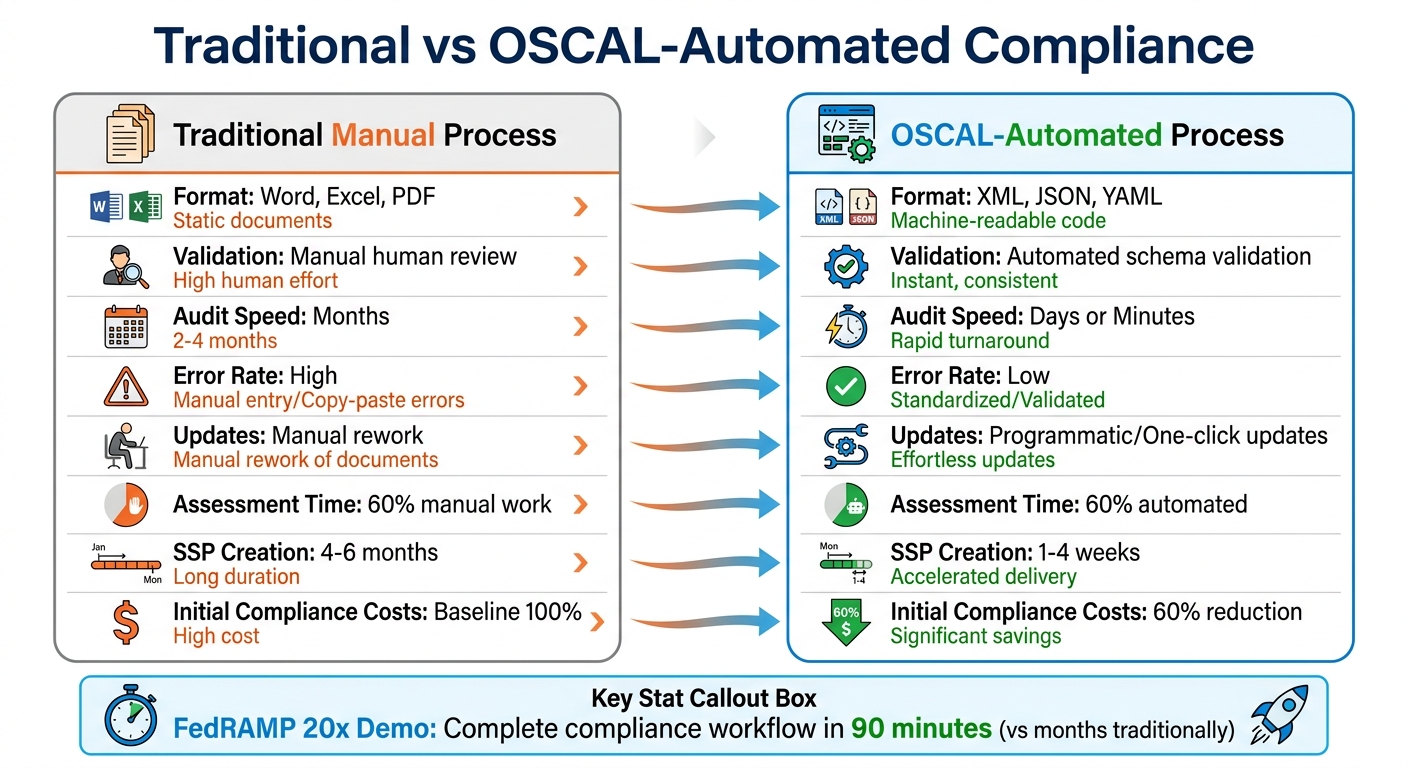
Traditional vs OSCAL-Automated Compliance: Speed, Accuracy, and Efficiency Comparison
Compliance teams often wrestle with audit delays, disconnected tools, and manual errors. OSCAL addresses these issues by converting static documents into machine-readable data.
Reducing Audit Delays and Errors
With machine-readable formats, tools can automatically validate schema compliance, flag missing controls, and highlight inconsistencies before auditor review.
| Feature | Traditional Manual Process | OSCAL-Automated Process |
|---|---|---|
| Format | Word, Excel, PDF (Static) | XML, JSON, YAML (Machine-readable) |
| Validation | Manual human review | Automated schema validation |
| Audit Speed | Months | Days or Minutes |
| Error Rate | High (Manual entry/copy-paste) | Low (Standardised/Validated) |
| Updates | Manual rework of documents | Programmatic/one-click updates |
Simplifying Third-Party and Vendor Risk Management
Vendor assessments are often repetitive and manual. OSCAL’s Component Definition model enables standardised sharing of security implementation data between vendors and customers, reducing repeated questionnaires and improving control inheritance clarity.
Managing Multi-Framework Complexity
OSCAL provides a single source of truth by linking controls across frameworks such as ISO 27001, SOC 2, GDPR, and FedRAMP. This reduces duplication and supports consistent control evidence across reports.
OSCAL and AI-Driven GRC Platforms
When paired with AI-driven GRC platforms, OSCAL’s structured format enables automated processing of security data and faster compliance operations.
How AI Enhances OSCAL
AI can:
- map controls across frameworks automatically,
- prioritise risks in POA&M items,
- convert regulatory requirements into machine-executable workflows,
- and support automatic detection and remediation triggers.
How CISOGenie Uses OSCAL
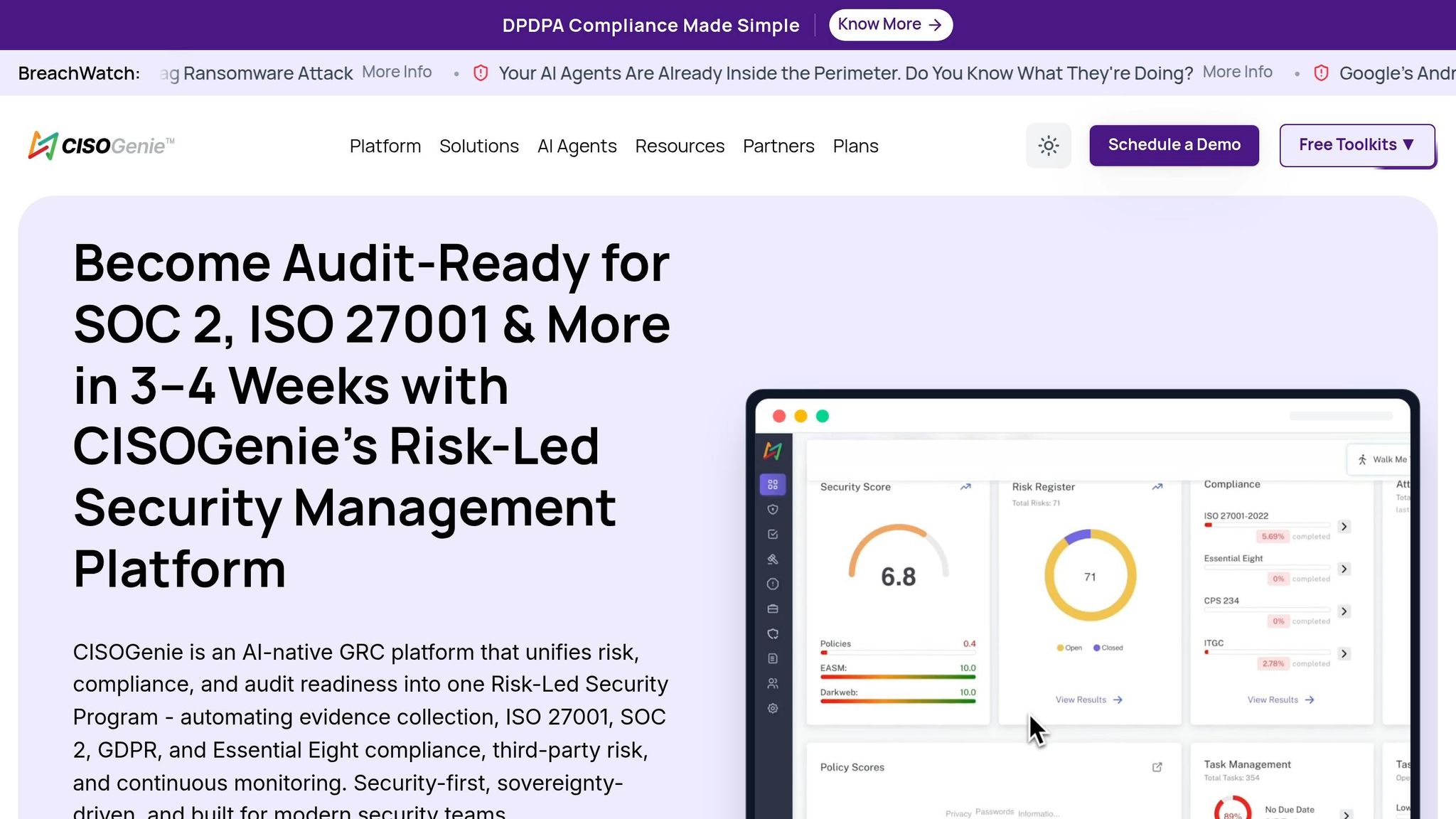
CISOGenie integrates OSCAL into AI-powered GRC workflows, enabling:
- evidence collection and validation across 35+ frameworks,
- policy conversion from legacy documents to machine-readable OSCAL formats,
- control mapping across ISO 27001, SOC 2, and GDPR,
- and improved vendor risk handling using OSCAL component models.
What’s Next for Compliance Automation
FedRAMP’s machine-readable package requirements are accelerating OSCAL adoption. Compliance tooling is moving toward interoperability, continuous validation, and agent-assisted workflows, with humans focusing on oversight, risk acceptance, and regulatory judgement.
Conclusion
OSCAL shifts compliance from static, document-heavy work to a dynamic, machine-readable model. It helps reduce delays, improve consistency, and support ongoing compliance at scale.
Key Takeaways
- Faster audits and unified compliance: Less duplicated effort across frameworks.
- Continuous monitoring with AI: Real-time validation and quicker gap detection.
- Reusable control data: Better consistency and lower manual rework.
Next Steps
Start small with one system or component. Use tools like NIST oscal-cli for validation, then scale into OSCAL-native workflows.
For organisations looking to accelerate implementation, platforms like CISOGenie can help convert legacy docs, automate evidence collection, and operationalise multi-framework compliance.
FAQs
Do we need to rebuild our compliance programme to use OSCAL?
No. OSCAL can be adopted incrementally. You can convert existing documentation and controls step by step while keeping your current compliance processes intact.
How does OSCAL help us stay continuously audit-ready for ISO 27001 and SOC 2?
OSCAL standardises controls and evidence in machine-readable formats, enabling continuous validation, faster updates, and easier reporting across ISO 27001 and SOC 2.
What’s the quickest way to start OSCAL without adding more tools and manual work?
Start with existing control catalogues and convert high-impact documentation into OSCAL (JSON/XML/YAML). Validate with oscal-cli, then expand to automated workflows and integrations.