CCM — The Definitive Path to Control testing and Operational Effectiveness
-
 Balachandran Sivakumar
 - 31 Dec, 2025
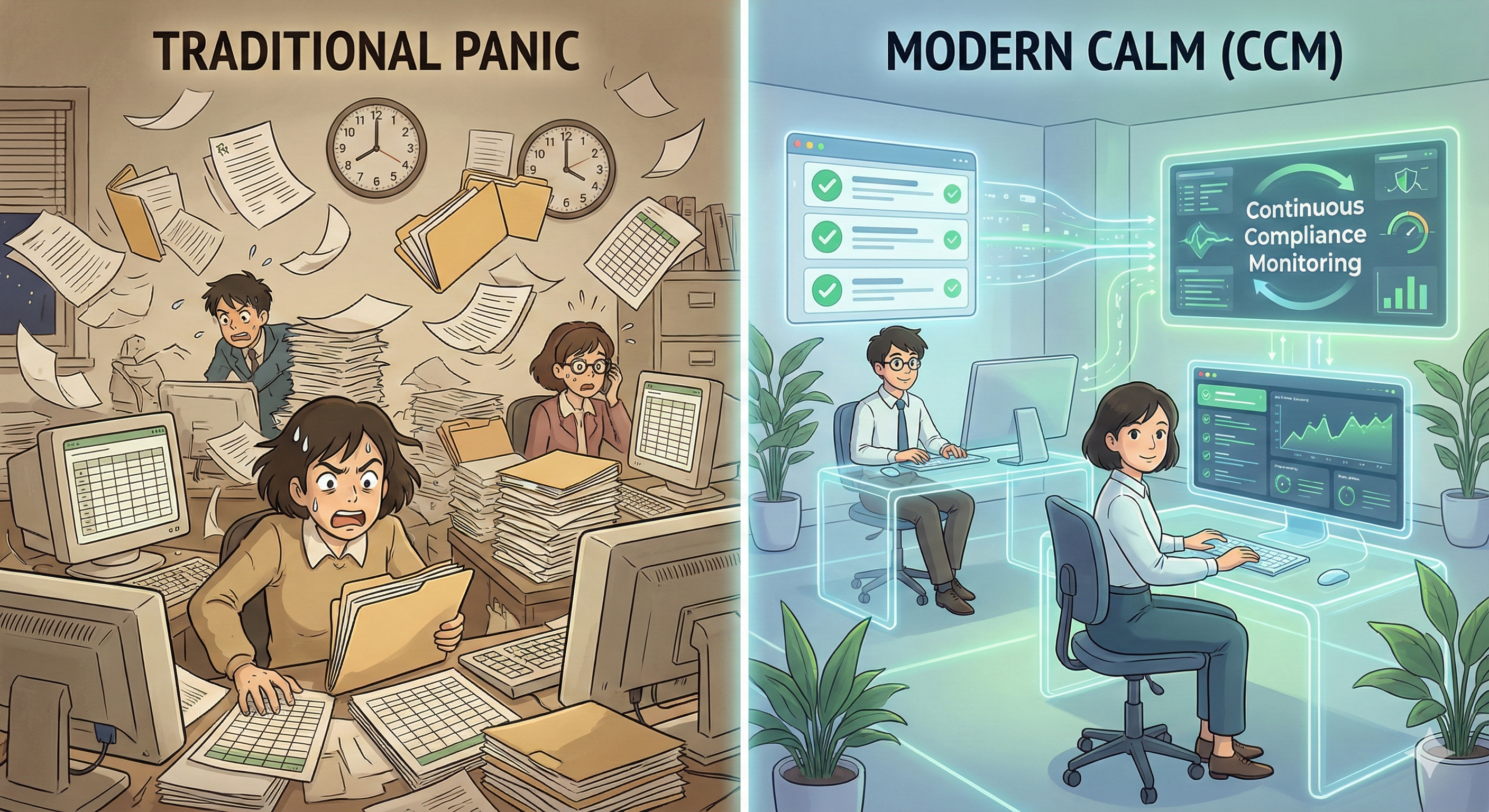
For decades, compliance has been treated as a periodic event. An audit approaches, spreadsheets multiply, people turn into spreadsheet jockeys, screenshots are collected, and teams scramble to prove that controls existed — at least at that moment in time. Once the audit is over, the machinery winds down, only to restart months later.
This model is broken. It burns money and effort for a checkbox filling exercise, as opposed to being a security boosting exercise.
Cloud-native infrastructure, SaaS delivery models, identity sprawl, CI/CD pipelines, and constant configuration change have rendered point-in-time assurance largely meaningless.
Static compliance cannot keep pace with dynamic systems
If compliance is about security and demonstrability, then the only scalable way in this era is Continuous Compliance Monitoring (CCM). It is the only credible path to sustained operational effectiveness.
Control Testing Was Never Meant to Be Manual
At a foundational level, all frameworks and standards, be it ISO 27001, SOC 2 or NIST 800–53, converge atthe same 2 fundamental questions
- Is the control designed appropriately?
- Is the control operating effectively over time?
The former needs a separate discussion. Shankar Jayaraman discusses that here in detail.
The second question — operational effectiveness — is the other half of the same story — be it a nimble startup with 15 people or a mammoth organization with 100,000 people, measuring, validating and enforcing controls is hard. On the nimble startup side, we have a small number of people, using sophisticated tools and LLMs to build, deploy and manage their offerings. On the other end of spectrum, there are 100 member teams building legacy applications on the mainframe. In both cases, we need to deal with Access Control, Logging & Monitoring, TPRM, Risk Registers etc.
One cannot possibly have the expertise, in either of those scenarios to completely do manual control testing for today’s highly complex technical environments. Nor should one do. That’s what automation is for.
Manual control testing:
- Is sample-based
- Is retrospective
- Depends on human attestation
- And collapses under scale
Worse, it creates a false sense of security. A control that “passed” in April may have silently failed in May, June, and July — undetected until the next audit.
What CCM Actually Means (Beyond the Buzzword)
Continuous Compliance Monitoring is often misunderstood as “running scripts” or “automated checks.” That’s an oversimplification.
True CCM is a control-centric operating model, where:
- Controls are expressed in machine-readable formats
- Evidence is collected continuously, not episodically
- Drift is detected close to real time
- Control status is derived from system state, not point-in-time logs or screenshots
- Assurance is always-on, not auditor-driven
In other words, CCM treats controls as living constructs, not static documents.
From Checkbox Compliance to Security-first Approach
Traditional audits answer: Does the control exist?
CCM answers a more important question: Is the control doing what it is supposed to do, right now?
This distinction is subtle — but profound.
Consider access control:
- A policy may exist
- Have service accounts accumulated excess access?
- Do we revoke access to employees who are no longer part of the organization?
With CCM:
- Control assertions are continuously evaluated
- Violations are signals, not surprises
- Evidence is generated as a by-product of operations
This is the difference between compliance satisfying a checkbox and compliance serving as a guiding light for security
Operational Effectiveness Is a Systems Problem
One reason CCM has been slow to adopt is that it exposes an uncomfortable truth:
Operational effectiveness cannot be “owned” by GRC alone.
Controls cut across:
- Cloud infrastructure
- Identity systems
- Endpoint management
- SDLC pipelines
- Vendor integrations
- Data flows
CCM forces a convergence:
- Security engineering defines how controls manifest
- GRC defines why they matter
- Systems continuously prove that they work
This is why CCM succeeds only when controls are mapped to observable system behavior, not abstract intent.
“Test Once, Comply Many” Becomes Real
The long-promised vision of test once, comply many has mostly been aspirational. Now, the CCF unifies controls and give you design effectiveness. And, CCM finally makes this vision executable.
When a single continuous test:
- Validates encryption at rest
- Confirms key rotation
- Verifies access restrictions
- Detects configuration drift
…the same signal satisfies multiple controls across multiple frameworks.
Not because of clever documentation — but because the underlying control reality is shared.
CCM Is a Business Enabler, Not a Tax
When implemented correctly, CCM delivers outcomes far beyond compliance:
- Reduced audit fatigue
- Early risk detection
- Faster remediation cycles
- Higher trust with customers
- Lower marginal cost for new frameworks
Most importantly, it restores credibility to the idea of compliance itself.
Compliance stops being a theater of proof — and becomes a byproduct of good operations.
In Closing…
At CISOGenie, such engineering challenges are what’s driving us everyday. The question we strive to answer every day is
“What can we do today to remove pain from the GRC or compliance process and make those effective?” — CISOGenie Team’s everyday guiding principle